Why Leaders in Global Teams Must Understand It Now
In today’s workplace, leaders rarely manage teams from one culture alone. You may lead people across countries, generations, and social norms — often without realizing that what feels like a “communication issue” is actually a cultural power issue.
One of the most important (and misunderstood) concepts in cross-cultural leadership is the Power Distance Index (PDI)— introduced by cultural researcher Geert Hofstede.
Understanding PDI is no longer optional for leaders. It directly affects how people speak, disagree, give feedback, and respond to authority.
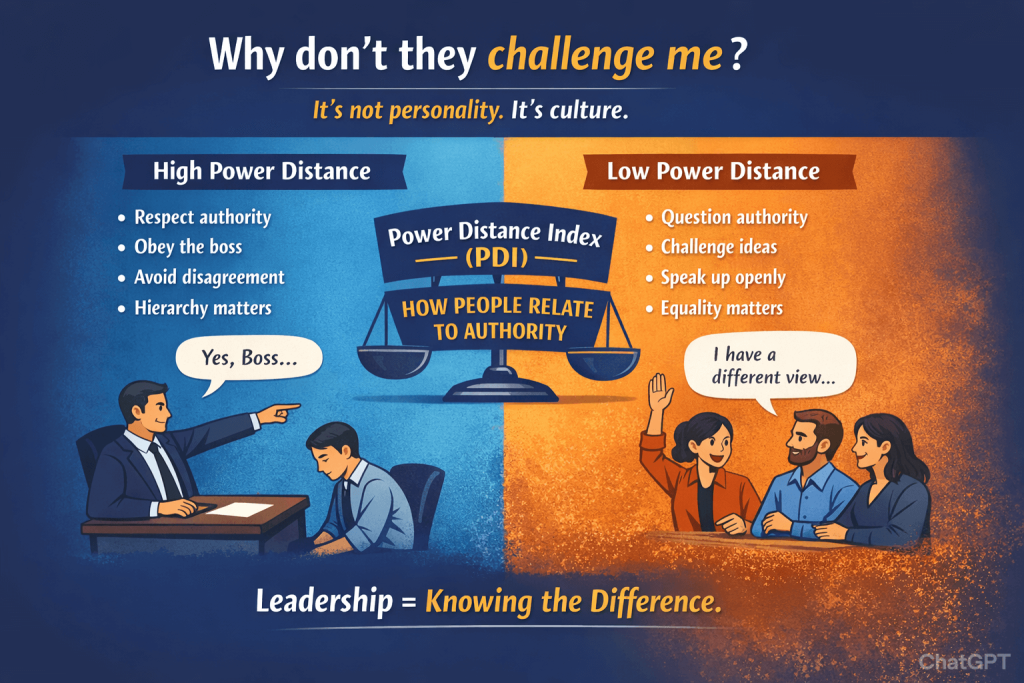
Power Distance Index refers to the degree to which people in a society accept unequal distribution of power as normal and legitimate.
In simple terms answers this question: How comfortable are people with hierarchy and authority?
high-PDI cultures, people tend to believe:
- Leaders should lead
- Subordinates should follow
- Questioning authority is risky
- Status and titles matter
low-PDI cultures, people tend to believe:
- Leaders are facilitators
- Everyone’s opinion has value
- Challenging ideas is healthy
- Equality matters more than rank
Neither is “better.” They are simply different cultural operating systems.
How PDI shows up in everyday workplace communication
Power Distance influences:
- Who speaks first in meetings
- Who challenges decisions
- How feedback is given
- How mistakes are reported
- How comfortable people feel saying “I disagree”
For example: A team member from a high-PDI culture may:
- Wait to be invited before speaking
- Avoid disagreeing with a manager
- Interpret direct criticism as personal disrespect
A manager from a low-PDI culture may:
- Expect open debate
- See silence as lack of initiative
- Assume disagreement is healthy
The result is not poor performance — it is cultural mismatch.
Why leaders must understand PDI now
1. Because miscommunication is being mistaken for incompetence
Many leaders unknowingly label culturally-driven behaviour as:
- Low confidence
- Poor ownership
- Weak leadership potential
When in reality, the person is following deeply learned rules about:
- Respect
- Authority
- Safety
PDI helps leaders separate: culture from capability.
2. Because innovation depends on voice
Modern organizations need:
- Dissent
- Critical thinking
- Risk reporting
- Questioning assumptions
But in high-PDI cultures, people are conditioned to:
- Protect hierarchy
- Avoid confrontation
- Stay silent in front of authority
Unless leaders consciously create space for voice, they will get:
- Compliance instead of contribution
- Agreement instead of insight
Understanding PDI allows leaders to design communication that unlocks thinking.
3. Because leadership style is not universal
What looks like “strong leadership” in one culture may look like:
- Arrogance in another
- Weakness in another
- Confusion in another
PDI explains why:
- Directive leadership works in some cultures
- Participative leadership works in others
Leaders who assume their style fits everywhere lose influence.
4. Because feedback fails without cultural awareness
In high-PDI cultures:
- Direct negative feedback can feel humiliating
- Public disagreement feels unsafe
In low-PDI cultures:
- Indirect feedback feels unclear
- Silence feels dishonest
Leaders who know PDI can:
- Choose the right tone
- Decide what to say publicly vs privately
- Avoid triggering shame or resistance
This is not about being “soft.” It is about being precise.
Why I teach PDI as a Leadership Communication Coach
As a leadership communication coach, I do not treat communication as just:
- Vocabulary
- Accent
- Confidence
- Presentation skills
I treat it as cultural behaviour.
Many of my clients say:
- “My team doesn’t speak up.”
- “They don’t challenge ideas.”
- “They agree in meetings and disagree later.”
- “My feedback doesn’t land.”
These are not language problems. They are power-distance problems.
Leaders must learn:
- When silence means respect
- When disagreement means engagement
- When politeness hides fear
- When authority blocks honesty
PDI gives leaders a diagnostic lens: Not “What is wrong with them?” But “What rules about power are they following?”
The real shift PDI invites
From this mindset:
“People should speak up if they have something to say.”
To this mindset:
“People speak up only when authority makes it safe.”
From this belief:
“Strong leaders command.”
To this belief:
“Effective leaders translate culture.”
In a global workplace, communication is never neutral
Every instruction, question, and piece of feedback carries:
- A cultural meaning
- A power signal
- A safety message
Leaders who ignore this lose:
- Trust
- Talent
- Insight
Leaders who understand it gain:
- Voice
- Alignment
- Psychological safety
- Better decisions
Power Distance Index is not about hierarchy. It is about how people relate to authority.
And leadership communication is not just about what you say — it is about what people feel safe enough to say back.
In a cross-cultural world, the most powerful leaders are not the loudest ones. They are the ones who know how power shapes speech.
***
If you lead across cultures and often wonder why your message doesn’t land the way you intend, this is exactly what I help leaders work through.
In a discovery call, we will: • identify where culture is shaping your communication • uncover what is blocking voice and honest input • clarify what needs to shift in your leadership approach
If this resonates, I invite you to book a discovery call to explore whether this work is right for you.