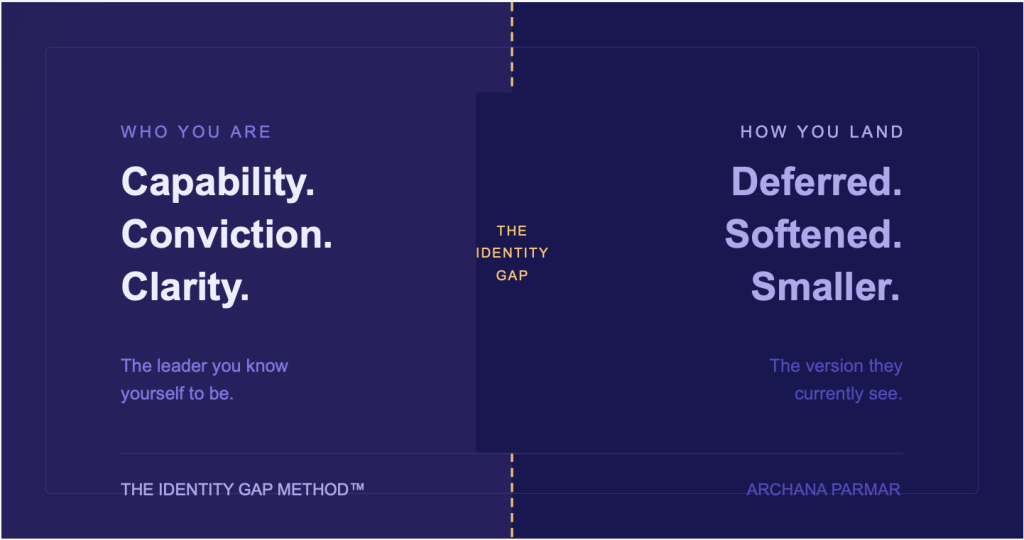
High-performing leaders often experience a particular kind of frustration. However, it is different from the frustration of failure. Instead, it comes from seeing the gap between where you are and where you should be, without knowing precisely what is creating it.
The feedback is always vague. “Work on your executive presence.” “Be more strategic.” “Own the room.” The advice is well-meaning and entirely useless — because it names the symptom while leaving the cause untouched.
After fourteen years and over 350 client engagements across finance, technology, healthcare, and beyond, Archana Parmar has identified the cause with precision. And it is not what most leadership development programmes assume it to be.
The gap is not a skills gap. It is an identity gap.
What is the identity gap?
The identity gap is the distance between who a leader actually is — their capability, their clarity, their conviction — and how they currently show up in the rooms that matter most.
It is the VP who is magnetic in one-on-one conversations but becomes strangely deferential in board meetings and the director who has the right answer in every session but consistently leaves the credit on the table. It is the senior manager who has been told she is “almost ready” for three consecutive years.
The gap isn’t caused by incompetence or poor communication skills. It’s caused by an identity that hasn’t kept pace with ambition.
Most leaders at this level are still operating from an identity that was forged earlier in their careers — one that was rewarded for being thorough, for being available, for being agreeable, for proving their value through volume of effort. That identity served them well in their first decade. It is now the primary thing holding them back.
Why skills training does not close the gap
The default response to “presence” and “communication” feedback is training. Better slide structure. Cleaner messaging frameworks. Storytelling techniques. Vocal modulation. These are useful skills. They are not the solution.
Skills training works on behaviour. Behaviour is downstream of identity. When a leader’s underlying identity does not shift — when they still, at some level, believe they need to prove themselves, over-explain their ideas, or soften their convictions to manage how they are received — no amount of structural improvement will hold.
The behaviour reverts the moment the coaching stops. This is why so many organisations invest significantly in leadership development and see limited lasting change. They are working on the output while leaving the generator untouched.
Performance reverts. Identity doesn’t.
The Identity Gap Method™: a three-phase approach
The Identity Gap Method™ is a proprietary coaching methodology developed by Archana Parmar specifically to close the distance between a leader’s current presence and the leadership identity their ambition requires. It operates across three phases.
Phase 1 — Diagnose
The first phase maps the gap with precision. This is not a generic 360-degree assessment or a personality inventory. It is a structured diagnostic process that identifies the specific rooms, relationships, and recurring situations in which the gap is widest — and the specific identity patterns generating it.
For one client, the gap appeared specifically in conversations with people more senior than them — not in peer or downward relationships, where they were consistently excellent. For another, it appeared only in high-visibility situations — large meetings, all-hands sessions, stakeholder presentations — while being entirely absent in smaller settings.
The Diagnose phase makes the gap visible, specific, and workable. You cannot close a gap you cannot see.
Phase 2 — Rebuild
The second phase works on the identity patterns that are generating the behaviour — not the behaviour itself. This includes language patterns, physical presence, the relationship to authority, how silence is occupied, how conviction is held under pressure, and how space is taken in high-stakes environments.
The distinction between working on identity and working on behaviour is critical and frequently misunderstood. Identity-level work changes the source. Behaviour-level work changes the output. The same output produced from a different source feels — and lands — entirely differently in a room.
A leader who has rebuilt their identity around authority does not perform confidence. They are it. The room responds to the difference.
Phase 3 — Anchor
The third phase ensures the shift is durable. This is where most coaching engagements fall short — the change is real in the session, in the coaching relationship, in the presence of the coach. But it does not fully transfer to the leader’s independent operation.
The Anchor phase installs practices and reference points that make the new identity self-sustaining — so it travels into every room, every conversation, every high-stakes moment, without external reinforcement. The goal of the Identity Gap Method™ is not that the leader is different with Archana. The goal is that they are permanently different everywhere.
What the method produces
93% of leaders who work through the Identity Gap Method™ are promoted within 18 months. This is not primarily because they became better communicators. It is because the organisation encountered a different person — one whose presence, authority, and identity matched the level to which they were being considered.
The shift is consistently described by clients in identity terms rather than skill terms. Not “I present better now” but “I stopped performing confidence and started being it.” Not “I use better frameworks” but “I walk into those rooms differently now.” and Not “I handle difficult conversations more effectively” but “I am not afraid of them anymore.”
These are identity shifts. They are precisely what the method is designed to produce.
Who the method is for
The Identity Gap Method™ was developed for senior leaders who are already high-performing — people for whom the problem is not competence or work ethic, but the gap between their capability and how fully it lands in the rooms that determine their trajectory.
It is for corporate leaders approaching the transition to director or executive level. It is for founders who have built something significant and now need to lead it at a scale they did not train for It is for women in senior roles navigating the particular double-bind of leadership identity and It is for creative professionals, coaches, and consultants whose expertise is evident but whose authority is not yet fully expressed.
The gap looks different in each context. The method is the same.
If you recognise the gap described in this article — the distance between your capability and how you currently land — The Identity Gap Method™ was built precisely for this. Learn more or book a discovery call at https://calendly.com/archanaparmar/lets-discover-you