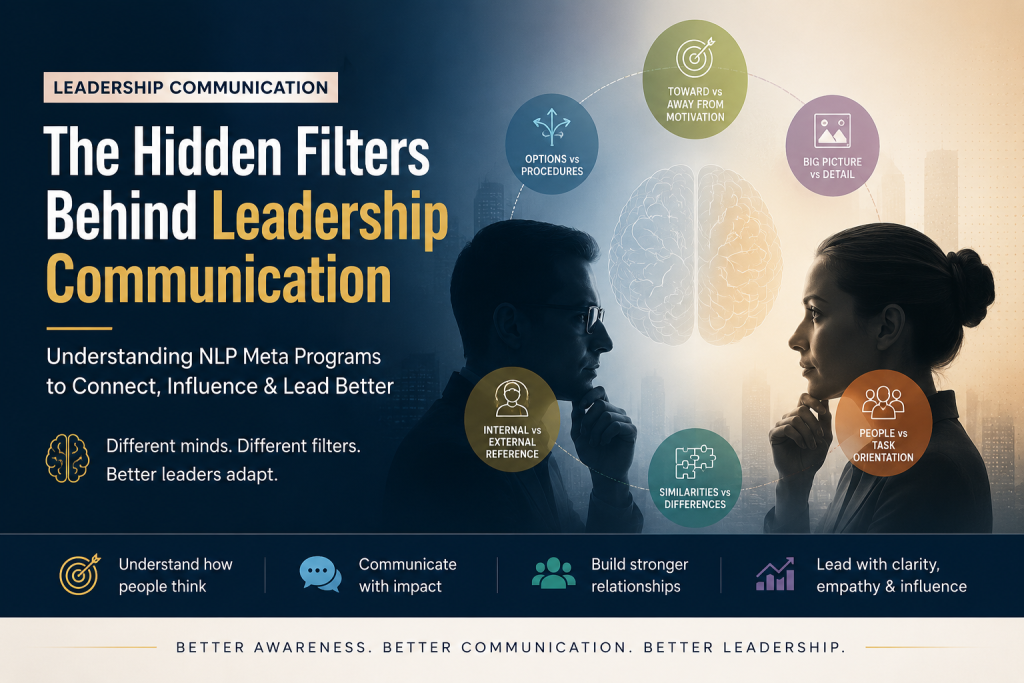
Meta Programs are one of the most fascinating and practical frameworks within NLP because they reveal how people think, decide, interpret, and communicate. As a leadership communication coach and NLP Master Practitioner, I often tell leaders this:
Communication challenges are rarely only about words.
They are usually about filters.
Two intelligent people can sit in the same meeting, hear the same sentence, and walk away with completely different interpretations. Why? Because human beings do not respond to reality directly — they respond to their internal representation of reality.
This is where Meta Programs become incredibly powerful.
Meta Programs are unconscious mental patterns that shape how individuals process information, respond to situations, make decisions, engage with people, and interpret communication. Once you begin to identify these patterns, leadership communication becomes far more intentional, adaptive, and effective.
Understanding Meta Programs in Leadership Communication
1. Toward vs Away From Motivation
One of the most visible Meta Programs in leadership environments is motivational orientation.
Toward-Oriented Individuals
These individuals are driven by:
- Achievement
- Growth
- Vision
- Possibility
- Rewards
They naturally focus on:
- What can be achieved
- Future opportunities
- Desired outcomes
You will often hear statements such as:
- “Let’s make this happen.”
- “This is a great opportunity.”
- “I want to achieve this target.”
These individuals are energized by aspiration.
Away From-Oriented Individuals
These individuals are motivated by:
- Avoiding failure
- Reducing risk
- Preventing mistakes
- Maintaining stability
Their attention naturally goes toward:
- Potential issues
- Risks
- Delays
- Problems that may arise
You will hear statements like:
- “We need to avoid errors.”
- “This could become a concern.”
- “I don’t want unnecessary delays.”
These individuals are energized by safety and protection.
Leadership Insight
Many leaders unintentionally communicate only in a “Toward” language:
- Vision
- Ambition
- Innovation
- Big goals
But teams often contain both motivational types.
A Toward-oriented employee may feel inspired by:
“This project could transform the business.”
An Away From-oriented employee may respond better to:
“This approach minimizes long-term risk and operational disruption.”
Exceptional communicators know how to speak both languages.
2. Options vs Procedures
This Meta Program influences how people approach work, structure, and execution.
Options-Oriented Individuals
These individuals:
- Love flexibility
- Explore alternatives
- Enjoy creativity
- Resist rigid systems
They say:
- “There are many ways to do this.”
- “Let’s explore possibilities.”
- “Can we try a different approach?”
They thrive in environments that allow innovation and autonomy.
Procedures-Oriented Individuals
These individuals:
- Prefer structure
- Value predictability
- Need clear steps
- Feel comfortable with systems and frameworks
They say:
- “What’s the process?”
- “What’s the standard method?”
- “Can you outline the steps?”
They thrive when expectations and workflows are clearly defined.
Leadership Insight
This mismatch creates enormous workplace friction.
Creative leaders often become frustrated with process-heavy teams because they perceive them as slow or rigid.
Process-driven teams become frustrated with visionary leaders because they perceive them as chaotic or unclear.
Neither is wrong.
They simply process the world differently.
Strong leaders know when to provide:
- Freedom
- Structure
- Exploration
- Clarity
depending on who they are communicating with.
3. Big Picture vs Detail
This Meta Program determines how people absorb and communicate information.
Big Picture Thinkers
These individuals focus on:
- Strategy
- Vision
- Concepts
- Future direction
They want:
- Headlines
- Themes
- Outcomes
- The “why”
They can become impatient with excessive detail.
Detail-Oriented Thinkers
These individuals focus on:
- Accuracy
- Precision
- Execution
- Specifics
They want:
- Data
- Supporting evidence
- Clear explanations
- Operational detail
They can become uncomfortable with vague or abstract communication.
Leadership Insight
One of the most common executive communication mistakes is presenting detail before context.
Senior leaders often want:
- The conclusion
- The impact
- The recommendation
before they want the analysis.
Meanwhile, operational stakeholders may require:
- Numbers
- Logic
- Breakdown
- Process implications
Great communicators adapt the depth of communication to the audience.
4. Internal vs External Reference
This Meta Program influences confidence, validation, and decision-making.
Internal Reference Individuals
These individuals trust:
- Their own judgment
- Personal instincts
- Internal standards
They say:
- “I know this is right.”
- “I trust my assessment.”
They may appear highly confident and independent.
External Reference Individuals
These individuals seek:
- Feedback
- Consensus
- Validation
- Social proof
- Data confirmation
They say:
- “What do others think?”
- “Can we validate this?”
- “Do we have feedback on this?”
They often make decisions more collaboratively.
Leadership Insight
Managers frequently misread these patterns.
An Internal Reference employee may not need constant feedback — they value autonomy and trust.
An External Reference employee may require reassurance, discussion, and validation before committing fully.
The problem begins when leaders impose their own decision-making style onto others.
Leadership communication becomes far more effective when leaders recognize:
- Who needs independence
- Who needs alignment
- Who needs affirmation
- Who needs ownership
5. Similarities vs Differences
This Meta Program affects perception, feedback, and analytical thinking.
Similarities-Oriented Individuals
These individuals naturally notice:
- Connections
- Patterns
- Alignment
- Commonality
They focus on:
- What works
- Shared understanding
- Continuity
They help create collaboration and cohesion.
Differences-Oriented Individuals
These individuals naturally notice:
- Gaps
- Errors
- Inconsistencies
- Risks
- What is missing
They focus on:
- Improvement
- Correction
- Optimization
They are often highly analytical and critical thinkers.
Leadership Insight
Difference-oriented people are incredibly valuable in:
- Risk management
- Strategy
- Quality control
- Problem-solving
However, they are frequently misunderstood as:
- Negative
- Difficult
- Overly critical
In reality, they are often simply noticing what others overlook.
Emotionally intelligent leaders learn how to:
- Appreciate critical thinkers
- Prevent defensiveness
- Channel analytical thinking productively
6. People vs Task Orientation
This Meta Program strongly affects leadership style and workplace dynamics.
People-Oriented Individuals
These individuals prioritize:
- Relationships
- Harmony
- Team dynamics
- Emotional connection
They care deeply about:
- Collaboration
- Inclusion
- Morale
- Trust
Task-Oriented Individuals
These individuals prioritize:
- Results
- Efficiency
- Productivity
- Speed
They focus on:
- Goals
- Execution
- Performance
- Outcomes
Leadership Insight
Many workplace misunderstandings emerge from this exact mismatch.
People-oriented employees may perceive task-focused leaders as cold or transactional.
Task-oriented leaders may perceive relationship-focused individuals as inefficient or overly emotional.
Both perspectives have value.
Exceptional leaders learn how to balance:
- Human connection
- Accountability
- Empathy
- Performance
rather than over-identifying with only one orientation.
How to Identify Meta Programs
Meta Programs reveal themselves through language and behaviour patterns.
Listen carefully to:
- Repeated words
- Emotional reactions
- Decision-making styles
- Attention patterns
- What people naturally focus on
For example:
“What could go wrong?”
suggests:
- Away From orientation
- Detail focus
Whereas:
“What’s the opportunity here?”
suggests:
- Toward orientation
- Big Picture thinking
The more consciously you observe these patterns, the more adaptable and influential your communication becomes.
Final Thought
Leadership communication is not only about speaking well.
It is about understanding:
- How people think
- What drives them
- What creates resistance
- What creates trust
- How they interpret meaning
Meta Programs offer leaders a profound advantage because they move communication from assumption to awareness.
And the moment communication becomes awareness-driven, influence deepens significantly.