A manager can know the business inside out, make sound decisions and deliver consistently, yet still struggle to get people moving in the same direction.
The problem isn’t always experience or technical ability. Sometimes, it’s the way they communicate a decision, handle disagreement, influence a stakeholder or respond when a conversation gets uncomfortable.
This is where so-called soft skills begin to matter.
I have worked with technically strong professionals, finance leaders, senior managers and emerging executives who were excellent at their jobs but found that the skills that made them successful as individual contributors did not automatically prepare them to lead others.
As responsibility grows, the nature of the job changes. You are no longer judged only by what you know or deliver personally. Your effectiveness increasingly depends on how well you help other people think, collaborate, make decisions and get things done.
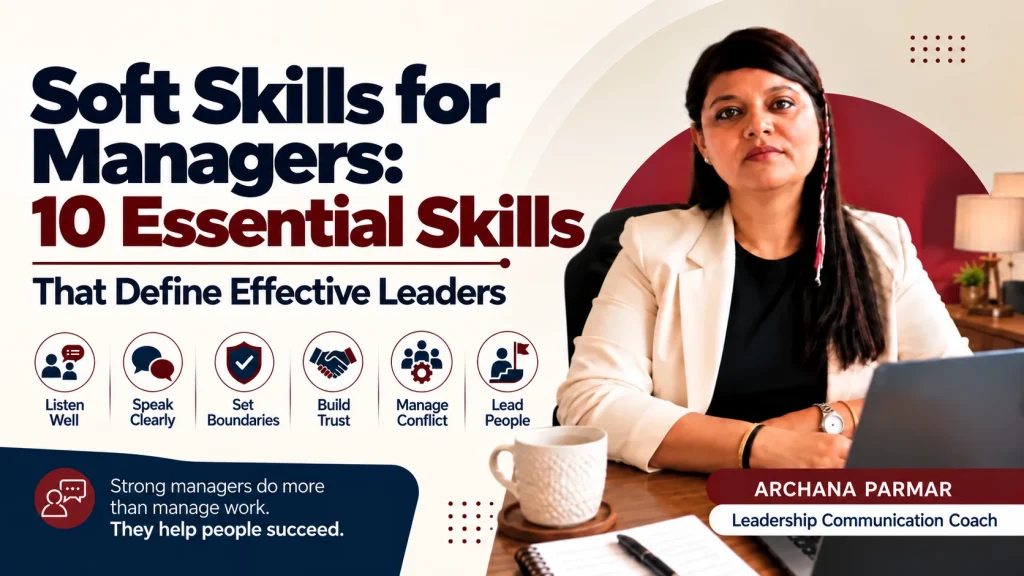
Here are ten skills that make a meaningful difference.
1. Strategic Communication: Make the Message Clear
Managers communicate all day, but communicating frequently is not the same as communicating effectively.
Strategic communication means knowing what your audience needs to understand, what decision they need to make and what action should follow. It is the difference between reporting everything that has happened and explaining what matters.
Consider a project review. You could spend five minutes walking through every development since the previous meeting, or you could begin with:
“We are on track to deliver, but one dependency needs attention. I recommend resolving it this week to avoid a delay.”
The second approach gives people a clear picture of the situation and a reason to act.
Strong managers do not simply pass on information. They give it direction, context and purpose.
2. Assertiveness: Be Clear Without Becoming Aggressive
Avoiding a difficult conversation can feel easier in the moment. Unfortunately, the issue rarely disappears.
A manager who accepts every request, avoids challenging unrealistic deadlines or struggles to give direct feedback can leave their team working with unclear expectations. What looks like flexibility may eventually become frustration.
Assertiveness is the ability to express your position, expectations and boundaries while respecting the other person.
It matters when you delegate work, negotiate priorities, challenge assumptions or tell a senior stakeholder that two deadlines cannot realistically be met at the same time.
For example:
“I can take this on, but completing it by Friday means moving the other priority to next week. Which would you prefer me to prioritise?”
You are not being difficult. You are making the trade-off visible so that a sensible decision can be made.
3. Executive Presence: Let Your Capability Show
Executive presence is often mistaken for looking confident, speaking loudly or having a naturally commanding personality. None of those qualities guarantees effective leadership.
It becomes visible in the way you communicate under pressure, present recommendations, handle questions and respond when someone disagrees with you.
Imagine a senior stakeholder challenging your proposal in a meeting. You could rush into a lengthy defence, retreat from your recommendation or become visibly irritated. Alternatively, you could acknowledge the concern, explain your reasoning and consider whether the challenge changes your position.
The third response communicates composure and judgement.
In leadership coaching, a recurring challenge is helping capable professionals ensure that their communication reflects the level at which they already operate.
The question is not whether you can become someone more impressive. It is whether people can see your existing capability in the way you behave.
4. Structured Thinking: Organise Your Thoughts Before You Speak
Complexity is part of a manager’s job. The ability to make sense of it without passing the confusion on to everyone else is a valuable leadership skill.
Before responding to a difficult question or presenting a recommendation, pause and ask yourself four things:
- What is my main point?
- What supports it?
- What does it mean for the business or team?
- What needs to happen next?
This simple discipline can change the quality of a conversation.
Suppose a project is falling behind because several teams depend on one another. Instead of describing every problem in chronological order, explain the main bottleneck, its consequences and the action needed to resolve it.
Structured thinking helps you separate the important from the incidental. It also makes your communication easier for others to follow and act on.
5. Active Listening: Understand What Is Behind the Words
Listening is easy when you agree with someone. It becomes more demanding when you are busy, under pressure or convinced that you already know the answer.
For managers, active listening means paying attention to more than the words being spoken. You need to understand the concern, motivation or uncertainty behind them.
A team member who repeatedly questions a deadline may not be resisting accountability. They may be worried about the quality of the work, unclear about priorities or reluctant to admit that the workload is unmanageable.
Responding with another instruction may miss the real issue.
A better question might be:
“What concerns you most about this deadline?”
That question creates space for a more useful conversation.
Listening does not mean agreeing with every concern. It means understanding the situation well enough to respond appropriately.
6. Audience Adaptability: Explain What Matters to Them
The same information can be useful to one person and irrelevant to another. Managers need to recognise that difference.
An engineer may need to understand the technical architecture and its limitations. A CFO may want to know the cost, financial exposure and return. A CEO may need the strategic implications and the decision required. A client may care most about the effect on delivery or service.
Your expertise remains the same, but the way you explain it should change.
For instance, rather than describing the technical details of a proposed system change to the CEO, you might say:
“The change will reduce operational complexity, but we need to allow additional time for implementation. I recommend proceeding once the transition plan is agreed.”
You have not removed the substance. You have framed it around the listener’s needs.
This is a key part of the move from specialist to leader: stop communicating only from what you know and start communicating from what the other person needs to understand.
7. Influence: Build Support Beyond Your Job Title
A manager’s authority has limits. You may own a project without controlling every team it depends on. You may need support from colleagues who report to someone else. You may have a sound recommendation that senior stakeholders are not yet ready to accept.
In these situations, simply repeating an instruction is unlikely to help.
Influence begins with understanding what matters to the people involved. What are their priorities? What risks concern them? What might they lose, gain or need to change if they support your proposal?
Suppose another department is reluctant to commit resources to your project. Instead of treating that reluctance as a lack of cooperation, understand what else is competing for its attention. You can then explain why your request matters, acknowledge the competing priorities and discuss a workable arrangement.
Influence is not about persuading people at any cost. It is about building enough understanding and trust for people to support a decision or take action.
8. Conflict Management: Challenge the Issue Without Attacking the Person
Disagreement is part of working with people who have different responsibilities, priorities and perspectives. The absence of visible conflict does not necessarily mean a team is working well. Sometimes, it means people have stopped raising concerns.
The skill is to distinguish disagreement about an idea from a personal attack.
Imagine a colleague challenges your team’s approach during a planning meeting. You believe their proposal will create problems, but responding with “That won’t work” may turn a practical discussion into a contest.
Try a more specific response:
“I see the objective, but I have a concern about the implementation. How would this approach affect the teams that depend on us?”
You have challenged the proposal without questioning the colleague’s competence.
Good conflict management allows people to disagree, examine the facts and reach better decisions without damaging working relationships unnecessarily.
9. Adaptability Under Pressure: Stay Effective When Things Go Wrong
A manager’s usual communication habits can change when the situation becomes uncomfortable.
An unexpected question may trigger over-explanation. A missed deadline may lead to defensiveness. A difficult stakeholder may prompt excessive accommodation. A crisis may cause someone to stop listening and start issuing instructions.
These responses are understandable, but they can make a difficult situation harder to manage.
Adaptability means recognising what the moment requires and responding deliberately rather than automatically.
When a senior leader asks why a delivery has slipped, for example, resist the urge to justify every decision that led to the delay. State what happened, explain the current impact and outline the next steps.
You might say:
“The delay came from an unresolved dependency. We have identified the issue, and I am working with the other team on a revised delivery plan. I will confirm the updated timeline once that dependency is resolved.”
The aim is not to remain perfectly calm in every situation. It is to remain useful when conditions are less comfortable.
10. Self-Awareness: Understand the Difference Between Intention and Impact
A manager may intend to be thorough but come across as someone who cannot get to the point. They may intend to be helpful but leave their team feeling micromanaged. They may believe they are being flexible while others experience them as inconsistent.
The intention may be reasonable. The impact still matters.
Self-awareness begins with the willingness to examine that gap without immediately defending yourself.
Ask for specific feedback. Notice how people respond when you speak. Pay attention to recurring problems in meetings, delegation or stakeholder conversations.
Then make an adjustment.
If your team regularly asks for clarification after you assign work, the answer may not be to repeat the instructions more forcefully. You may need to define the expected outcome, deadline and level of independence more clearly.
Self-awareness becomes a leadership skill when it changes behaviour. Reflection alone is not enough.
Why Calling These Skills “Soft” Misses the Point
Communication, assertiveness, listening, influence and emotional awareness may be labelled soft skills, but the situations in which managers use them are rarely trivial.
These are the capabilities that help managers set expectations, resolve disagreements, build trust, develop people and make decisions understood across a team.
Technical expertise can tell you what needs to be done. It cannot, by itself, ensure that people understand the priority, agree on the approach or work together to deliver it.
As a manager moves further away from individual execution and takes greater responsibility for people and outcomes, these capabilities become increasingly central to the job.
They are not an optional addition to leadership. They are part of the work itself.
Don’t Try to Improve All Ten Skills at Once
Leadership development can become an exercise in collecting frameworks. A manager attends a programme, learns a list of competencies and returns to work with plenty of new terminology but few changes in behaviour.
A better starting point is to identify the one behaviour currently limiting your effectiveness.
Perhaps you do not need to become more assertive in general. You need to disagree more comfortably with senior stakeholders.
Perhaps your presentations are already well prepared, but you need to state your recommendation earlier.
Or perhaps you have the right answer but tend to abandon it as soon as someone challenges you.
Each problem calls for a different kind of practice.
Choose one high-value situation, define what you want to do differently and rehearse it. Start in a comfortable setting, then introduce realistic difficulty: less preparation time, interruptions, disagreement or pressure to respond quickly. Finally, apply the behaviour at work and review what happened.
A useful development cycle is:
Diagnose → Practise → Receive feedback → Practise again → Increase difficulty → Apply at work → Review the evidence.
The test is not whether you can explain the skill. It is whether you can use it when the conversation matters.
The Shift From Managing Work to Leading People
The manager-to-leader transition is not simply about adding more responsibilities. It changes how you create value.
Early in your career, your expertise may be demonstrated through the problems you solve yourself. As you take on greater responsibility, results increasingly depend on how well you communicate priorities, influence decisions, build cooperation and help other people perform.
That is why these skills deserve serious attention.
The most useful question is not, “Which soft skills should I learn?”
It is this:
“Which behaviour is currently limiting my ability to get results through other people, and what can I practise to change it?”
That is a practical starting point for leadership development. And it is where coaching can make a real difference: turning a useful insight into a behaviour you can rely on at work.