You can be the most knowledgeable person in the room and still lose the room.
You can have the right answer, make a sound recommendation and care deeply about your team, yet leave people feeling dismissed, confused or reluctant to support your decision. Often, the difference isn’t your expertise or your intentions. It’s how you respond when people disagree, expectations clash or a conversation takes an uncomfortable turn.
That is where emotional intelligence becomes a leadership skill.
I wouldn’t claim it is the single factor that determines who gets promoted. Career progression depends on performance, business results, organisational priorities, opportunity and many other factors. But as professionals take on greater responsibility, their ability to manage themselves and work effectively with others becomes increasingly difficult to separate from their effectiveness as leaders.
Emotional intelligence is the ability to recognise emotions, understand their influence and choose how to respond. Much of its value lies not in what you know about yourself, but in what you do with that knowledge when it matters.
Emotional intelligence is revealed in difficult conversations
Nobody demonstrates emotional intelligence simply by describing themselves as self-aware or empathetic. You see it when a stakeholder challenges a recommendation, a team member questions a decision or a senior executive asks why something has gone wrong.
Consider a manager whose proposal is challenged in a leadership meeting. They might listen to the objection, examine the concern and respond thoughtfully. Or they might interrupt, defend every assumption and spend the next five minutes trying to prove that their original thinking was sound.
Both managers may have comparable expertise. The difference is what happens when their judgement is put under pressure.
In leadership coaching, assessments can help identify patterns worth exploring. But the more useful questions concern observable behaviour: What happens when this person feels criticised? Can they listen without preparing a rebuttal? Do they recognise the effect their words have on others? Can they recover when a conversation goes badly?
Those are the moments in which emotional intelligence becomes visible.
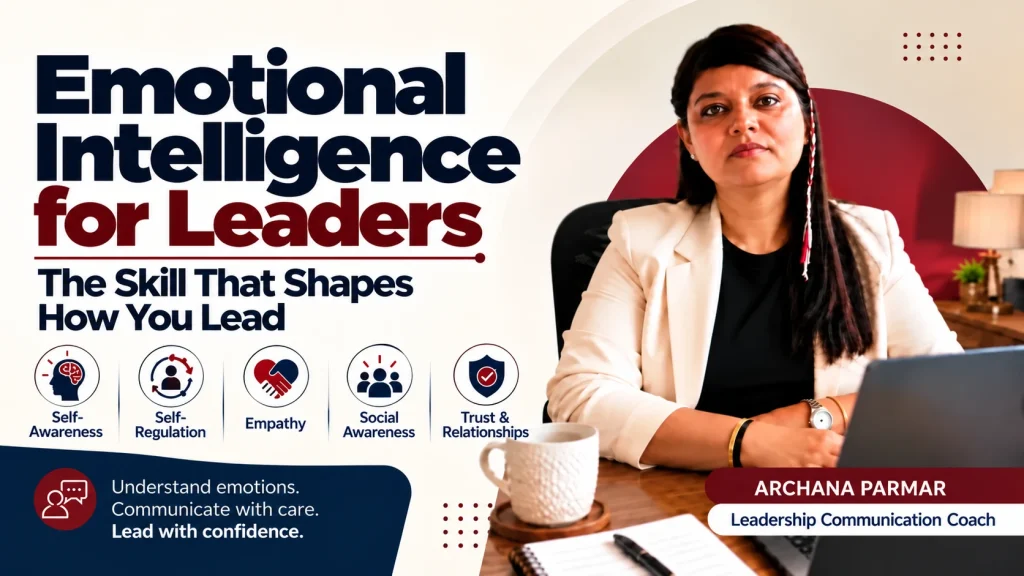
1. Self-awareness: Recognise the gap between intention and impact
Most communication problems don’t begin with bad intentions. They begin with a mismatch between what someone means to do and what other people experience.
A leader intends to be thorough but overwhelms the team with detail. They want to be helpful but keep stepping into work that belongs to someone else. They try to remain flexible, yet their reluctance to make a decision leaves everyone uncertain about the next step.
Without self-awareness, these patterns are easy to miss. You judge yourself by what you intended; other people judge the experience of working with you.
The starting point is to become curious about that gap. What feedback keeps coming up? Which conversations leave you frustrated? When do you find yourself explaining more than necessary, avoiding a difficult message or reacting more strongly than the situation warrants?
Awareness creates an opportunity to change, but it isn’t the change itself.
Ask yourself: What will I do differently the next time this situation occurs? That question turns reflection into a practical leadership habit.
2. Self-regulation: Create space between the trigger and your response
Pressure tends to expose familiar communication habits. One person becomes defensive, another starts talking faster, someone else withdraws, and another agrees too quickly just to restore harmony.
These reactions are understandable, but they can make a difficult conversation harder than it needs to be.
Imagine a senior stakeholder saying, “I don’t think you’ve considered the operational risk.” Your first instinct might be to explain why you have. But a more useful response could be, “Let me understand which part of the operational risk concerns you most.”
That small change creates room for a better conversation. You haven’t conceded the argument or abandoned your recommendation. You’ve chosen to understand the challenge before responding to it.
Self-regulation isn’t about suppressing emotion or pretending that criticism doesn’t bother you. It is about recognising the reaction without allowing it to dictate your next move.
A brief pause, a clarifying question or a deliberate decision to lower your pace can be enough to change the direction of an exchange. The aim is not to feel nothing. It is to remain capable of thinking while you feel something.
3. Empathy: Understand what the other person needs from the conversation
Two people can look at the same decision and see entirely different problems.
An engineer may be concerned about technical reliability. The CFO may be weighing cost and financial exposure. The CEO may be focused on strategic consequences, while the client wants to know whether the promised outcome will still be delivered.
None of these perspectives is necessarily wrong. Each reflects a different responsibility and set of concerns.
Empathy helps you recognise those differences without assuming that everyone sees the situation as you do. It doesn’t require agreement, nor does it mean putting another person’s preferences ahead of your responsibilities.
A useful shift is to move from asking, “What do I need to explain?” to asking, “What does this person need to understand before they can make a decision?”
That question changes how you prepare, what information you prioritise and how you frame your recommendation. It also makes your expertise more useful to the people who depend on it.
4. Social awareness: Read the situation, not just the words
Leadership conversations happen within a wider context. Reporting lines, competing priorities, existing relationships, cultural expectations and previous decisions can all influence how a message is received.
A technically correct answer may still miss the point if it ignores what the room is trying to resolve. A direct challenge might be appropriate in a private discussion but counterproductive in a meeting where the real issue is a lack of shared understanding.
Social awareness means paying attention to what is happening around the words. Is the stakeholder concerned about the recommendation itself, or about being accountable for its consequences? Is the team resisting a change because they disagree with the direction, or because they don’t understand how it will affect their work?
You won’t always interpret these signals correctly, and assuming you can read everyone’s mind is a mistake. Sometimes the best approach is to ask.
“What would you need to see to feel comfortable with this decision?” may reveal more than another round of argument.
Social awareness is not about playing politics. It is about understanding the context well enough to respond appropriately.
5. Relationship management: Be direct without damaging trust
Leadership involves conversations that people may not want to have. You will need to challenge a colleague’s assumptions, tell a client that a deadline cannot be met, address poor performance or explain why a preferred option isn’t the right one.
Avoiding these conversations may preserve comfort in the moment, but it often creates bigger problems later. On the other hand, delivering a difficult message without regard for its impact can damage trust and make people less willing to engage.
The skill lies in being clear about the issue while remaining respectful towards the person.
You might say, “I understand why that deadline matters. However, committing to it would put the quality of the delivery at risk. I recommend we agree on a realistic date rather than make a promise we may not be able to keep.”
The position is firm. The reasoning is clear. The other person is not being attacked.
This is the balance emotionally intelligent leaders learn to maintain: challenge the idea without diminishing the person.
You can be empathetic and still say no. You can listen carefully and still hold someone accountable. You can disagree without turning a difference of opinion into a personal conflict.
Why strong professionals sometimes struggle when they become leaders
Technical and specialist roles often reward depth, precision, independent problem-solving and getting the answer right. Those capabilities remain valuable throughout a career.
Leadership adds a different set of demands. You must influence people whose priorities differ from yours, make decisions with incomplete information, manage disagreement, delegate responsibility and maintain relationships while holding people to account.
A professional who has built a career on solving problems personally may struggle to let others find their own solutions. Someone accustomed to defending technical accuracy may find it difficult to hear a challenge without treating it as a test of competence.
These are not necessarily signs of poor leadership potential. They often reflect habits that worked well in one role but need adjusting in another.
The transition from expert to leader requires more than learning new responsibilities. It requires learning how your behaviour affects the people who must work with you.
Emotional intelligence must hold up when the pressure rises
Understanding a principle in a calm conversation is different from applying it when someone challenges you in front of senior colleagues.
That is why leadership development needs practice, not just reflection.
Start with a realistic situation. It could be a stakeholder disagreeing with your proposal, an employee pushing back on feedback or a senior executive asking an unexpected question. First, practise your response when you have time to prepare. Then try again without preparation, with an interruption, with strong disagreement and under a tight time limit.
Finally, apply the behaviour in a real workplace conversation and reflect on what happened.
Did you listen before responding? Did you ask a question instead of making an assumption? Were you clear about your position? Did your response help resolve the issue, or did it turn the conversation into a contest?
The point is not to perform a flawless response. It is to make a more effective response available when your usual habits threaten to take over.
Emotional intelligence becomes a capability when you can use it under pressure, not merely describe it when things are going well.
Being emotionally intelligent does not mean being agreeable
There is a persistent misconception that emotionally intelligent leaders are always calm, accommodating and pleasant to deal with. That interpretation misses the point.
Strong leaders set boundaries, challenge poor performance, make unpopular decisions and communicate uncomfortable truths. Emotional intelligence does not remove those responsibilities. It helps leaders fulfil them without creating unnecessary damage along the way.
The difference is not whether you experience frustration or disagreement. It is whether you can recognise what is happening, understand the situation and choose a response that serves the issue rather than simply expressing your immediate reaction.
A leader who can remain respectful while delivering difficult feedback is not being soft. A leader who can reconsider a decision without becoming defensive is not being indecisive. Both are demonstrating control over how they lead.
The leadership advantage is in what you do next
When I think about emotional intelligence in leadership, I return to a practical set of questions.
Can you recognise your triggers? Can you hear criticism without immediately defending yourself? Can you understand another person’s concerns without losing sight of your own responsibilities? Can you challenge someone directly while preserving their dignity? And when a conversation goes badly, can you reflect, repair the relationship and handle the next one better?
These are not abstract personality traits. They are behaviours that can be observed, examined and practised.
Emotional intelligence doesn’t replace expertise. It affects how effectively your expertise is communicated, how well your decisions gain support and how people experience working with you. The right answer can fail to gain traction if you communicate it poorly; a difficult decision can become easier to accept when people feel heard and understand the reasoning behind it.
So rather than asking whether you are emotionally intelligent, ask yourself a more revealing question:
What happens to my behaviour when a conversation becomes uncomfortable?
That is where the real work begins. You don’t need to eliminate every emotional reaction or become a different person. You need to recognise your patterns, make deliberate choices and practise responding in ways that reflect the leader you want to be.
Leadership is rarely tested when everyone agrees and everything is running smoothly. It is tested when priorities collide, someone pushes back and the easy response is not the most effective one.
That is where emotional intelligence stops being an idea and becomes a leadership capability.