You can deliver a polished presentation, know your subject inside out and still struggle when someone asks you a question you weren’t expecting.
A senior stakeholder turns to you in a meeting: “What’s your recommendation?”
Your CEO asks why a project is behind schedule. A client wants you to explain a complicated issue in plain English. Someone challenges your proposal, and everyone in the room waits for your response.
Suddenly, the words that seemed so clear in your head become difficult to organise. You start explaining the background, add a few qualifications, lose track of your main point and end up saying far more than the question required.
I’ve seen this pattern among experienced professionals, technical specialists, finance leaders and emerging executives. They rarely lack knowledge. What they struggle with is deciding, quickly, which part of that knowledge matters and how to communicate it clearly.
Effective impromptu speaking isn’t about having an answer to everything. It’s about knowing how to organise the answer you have.
Impromptu Speaking Is a Thinking Skill Before It’s a Speaking Skill
Many professionals assume they need to become quicker thinkers to speak well without preparation. That puts the emphasis in the wrong place.
You don’t need to produce brilliant answers instantly. You need a reliable way to make sense of a question, decide what you want to say and deliver it without making your audience sit through every step of your thinking.
The sequence is simple:
Think → Decide → Structure → Speak.
Without that sequence, people often think aloud. They introduce one idea, remember another, add context to explain the first, and eventually arrive at a conclusion that should have opened the conversation.
This is particularly noticeable in senior meetings, where people need to understand the issue, assess the options and make decisions without getting lost in unnecessary detail.
The aim is not to eliminate spontaneity. It is to give your spontaneous answers enough structure to be useful.
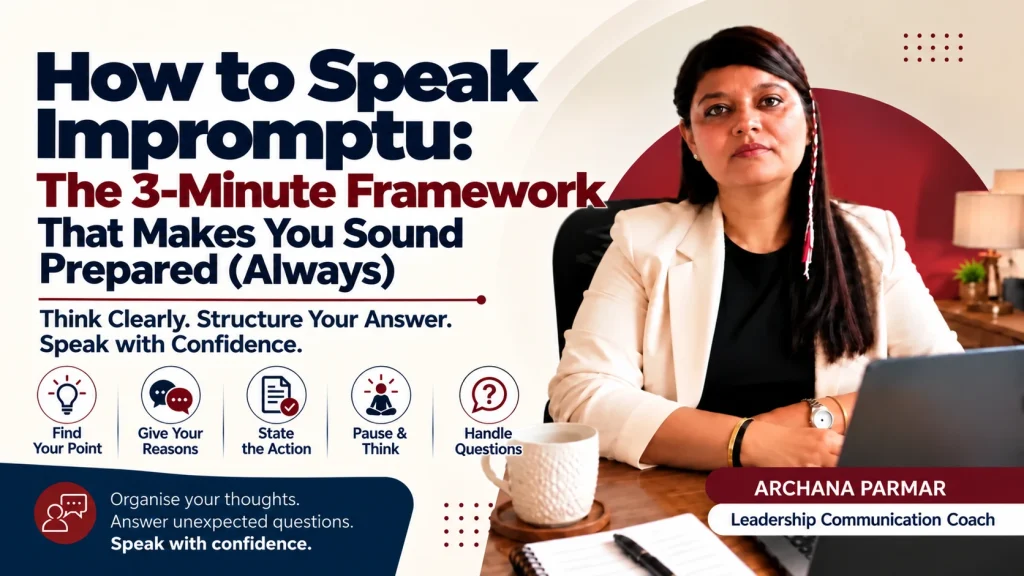
The Three-Minute Framework: Decide What Matters Before You Speak
When you have a few minutes before answering, resist the temptation to write a script. A script can be difficult to recall when the conversation takes an unexpected turn.
Instead, use those three minutes to answer three questions.
Minute 1: What is my main point?
Ask yourself: If the audience remembers only one thing I say, what should it be?
Write down one sentence that captures your position.
For example:
“I recommend delaying the launch by two weeks.”
That is your anchor. You can explain the reasoning later, but you should know where you stand before you begin speaking.
Minute 2: What are my strongest reasons?
Choose the two reasons that best support your position.
In this example, two critical reliability issues remain unresolved, and the additional testing time would reduce the risk of problems after launch.
You might know ten other details about the project. Some may be relevant if someone asks a follow-up question, but they don’t all belong in your opening answer.
This is where experienced professionals sometimes get caught out. Their depth of knowledge makes it difficult to leave things unsaid.
Impromptu speaking rewards judgement about what to include, not the ability to include everything.
Minute 3: What needs to happen next?
Consider what the audience needs to decide, understand or do with your answer.
You might finish with:
“My recommendation is to use those two weeks to resolve the reliability issues, complete testing and then proceed with the launch.”
Now you have a clear position, the reasons behind it and a practical next step.
The framework is:
Point → Reasons → Action.
Three minutes is enough to organise a useful response without rehearsing every word.
No Preparation Time? Use the Same Structure in Your Head
Of course, you won’t always get three minutes. Sometimes you have three seconds.
Imagine a colleague asks for your view on a proposed restructuring during a meeting. You haven’t reviewed the latest version of the plan, but you understand the business and the teams involved.
You could start talking about reporting lines, departmental history and possible complications. Or you could organise your answer around four simple elements.
- Point: “I think the restructuring could work, but decision ownership needs to be clearer.”
- Reason: “Two functions appear to have overlapping responsibilities.”
- Implication: “If we leave that unresolved, we could create more escalations rather than fewer.”
- Next step: “I’d clarify who owns each decision before finalising the structure.”
The response takes only a short time to deliver, yet it gives the audience something concrete to work with.
Notice what makes it effective. The speaker hasn’t memorised a clever answer. They have identified the central issue, explained why it matters and suggested what to do next.
That is what makes an unprepared response sound prepared.
The Most Useful Thing You Can Do Is Pause
Many professionals feel uncomfortable with silence. When a question comes their way, they begin speaking immediately because they believe a quick response demonstrates confidence.
It can do the opposite.
An immediate answer that wanders through several possibilities may create more uncertainty than a brief pause followed by a considered response.
Try saying:
“Let me think about that for a moment.”
Then take a breath, identify the main question and decide what you can reasonably say.
A pause of a second or two gives you space to organise your thoughts without requiring the audience to follow your internal debate. It also helps you manage your pace, particularly if you tend to speak quickly when nervous.
Composure is not the absence of thinking time. It is the ability to use that time deliberately.
When You Don’t Know the Answer, Protect Your Credibility
An unexpected question can expose the limits of your knowledge. Perhaps a stakeholder asks for a figure you don’t have, or your CEO wants an explanation for a development you haven’t yet investigated.
The temptation is to fill the gap with assumptions and hope your answer sounds convincing.
Resist it.
You can be clear about what you don’t know while still being useful.
For example:
“I don’t have the exact number with me, and I don’t want to give you an inaccurate figure. I’ll confirm it after the meeting. What I can explain now is the broader trend.”
This response separates what you know from what you need to verify. It also gives the listener a clear next step.
You don’t need to manufacture certainty to sound credible. In many professional situations, knowing where your information ends is part of good judgement.
When Someone Challenges You, Don’t Rush to Defend Yourself
A question becomes harder to answer when it carries criticism.
Consider a stakeholder asking, “Why didn’t your team anticipate this dependency?”
You might feel compelled to explain every decision that led to the problem. You might blame another team, defend the original plan or apologise repeatedly before addressing the actual issue.
A more effective response follows three steps:
Acknowledge → Answer → Act.
For example:
“We didn’t identify that dependency early enough. We’ve reviewed where the planning assumption failed, and we’re changing the review process to catch similar issues earlier.”
The answer accepts responsibility without becoming defensive. It addresses the concern and moves towards corrective action.
The same principle applies when you disagree with someone. If you find yourself saying, “I’m not sure that would necessarily be the best approach,” ask whether you are genuinely uncertain or simply reluctant to state your position.
If you have a considered view, say:
“I see it differently. I’d recommend Option A because it addresses the main risk without delaying the entire project.”
Assertiveness doesn’t require a louder voice or a harder tone. It requires a clear position supported by reasoning.
If You Start Rambling, Know How to Recover
Even experienced speakers lose their thread. You may begin with a clear answer, get interrupted by your own additional thoughts and realise halfway through that you’ve drifted away from the question.
The mistake is trying to rescue the entire explanation.
Instead, reset.
Say, “Let me simplify that,” or “The main point is this.”
Then return to your headline and finish the answer.
For example:
“The main point is that we’re ready to proceed, provided we resolve the outstanding compliance issue first.”
You don’t need to apologise for every imperfect sentence or explain how you lost your train of thought.
Strong communicators aren’t people who never lose their structure. They’re people who know how to find it again.
How to Practise Impromptu Speaking So It Holds Up Under Pressure
A framework may feel easy in a quiet coaching session and disappear the moment someone challenges you. That is why practising a response once or twice is rarely enough.
When I work with leaders on impromptu communication, the aim is not simply to produce a well-structured answer in a comfortable setting. The real question is whether they can maintain that structure when the conditions become less predictable.
A useful progression moves through eight stages:
- Familiar topic: Speak for three minutes about something you know well.
- No preparation: Choose a familiar topic and speak for two minutes without making notes.
- Unexpected question: Respond to a question you haven’t seen in advance.
- Follow-up challenge: Have someone question your reasoning or ask you to justify your recommendation.
- Interruption: Practise recovering your point when someone cuts in halfway through your answer.
- Opposing viewpoint: Respond to someone who disagrees with your position.
- Senior stakeholder simulation: Answer a difficult question from someone playing the role of a CEO, client or senior decision-maker.
- Real workplace application: Use the behaviour in an actual meeting, presentation or conversation.
This progression helps reveal the specific problem behind a general feeling of “I’m not good at impromptu speaking.”
One person may structure answers well but rush when challenged. Another may remain composed but bury the conclusion under too much context. Someone else may communicate confidently with peers but become hesitant around senior leaders.
Each requires a different kind of practice. Once you know where your communication breaks down, you can work on that behaviour rather than trying to improve everything at once.
The Framework Is Only the Beginning
The three-minute method gives you a starting point, but the deeper capability involves several skills working together: thinking clearly, selecting the right message, structuring your response, managing your delivery and recovering when the conversation changes.
With practice, the structure becomes more natural. You stop consciously searching for the perfect sequence and begin recognising what a useful answer needs.
That is the difference between memorising a communication technique and developing a skill you can rely on.
The real test isn’t whether you can deliver a three-minute speech on a familiar subject. It is whether you can give a clear, considered answer when you don’t know the question in advance.
Can you state your position? Explain your reasoning? Adapt to your audience? Acknowledge uncertainty? Handle disagreement without becoming defensive? Recover when interrupted?
These are the demands leaders face in ordinary working life. Meetings change direction, stakeholders raise unexpected concerns, and decisions rarely wait for everyone to prepare a polished response.
Your credibility in those moments depends less on having the perfect words ready and more on knowing how to think and communicate when they aren’t.
You don’t need an answer to every question. You need a dependable way to find the point, make your thinking clear and respond with composure.
That’s the real skill behind impromptu speaking.