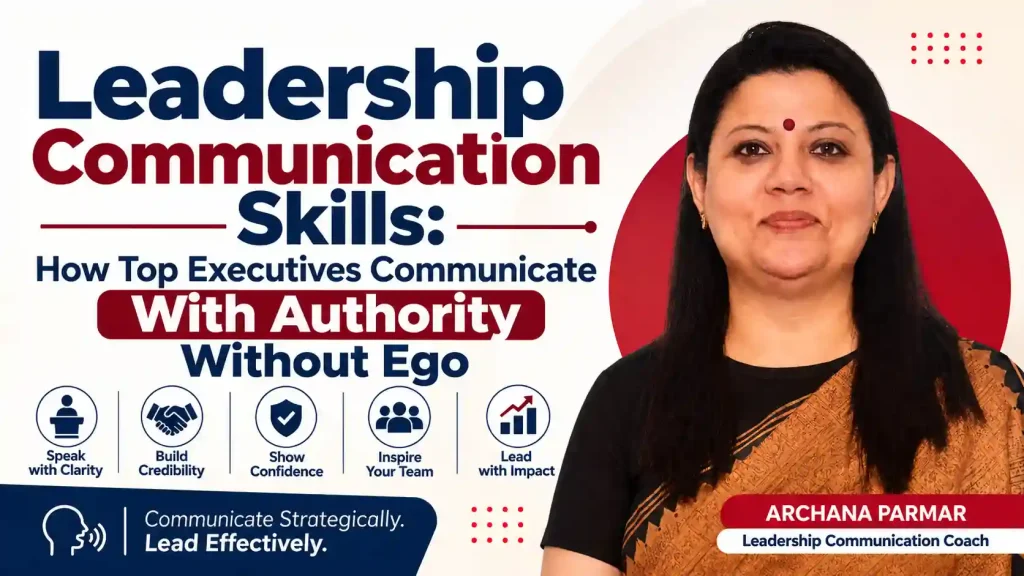
The higher you move in an organisation, the more your communication needs to evolve.
At the beginning of your career, speaking clearly, sharing information, and demonstrating your knowledge may be enough to establish credibility. However, as you take on greater responsibility, people expect much more from you.
They expect you to simplify complex situations, influence decisions, manage disagreements, build alignment, and provide direction even when all the answers are not available.
This is where leadership communication skills become essential.
As an executive, your role is no longer just to explain what you know. It is to help others understand what matters, make better decisions, and move towards a common goal.
Interestingly, some behaviours that helped you succeed earlier in your career can become limitations at a senior level.
The expert who explains everything needs to learn to communicate with greater focus. The high performer who always has an answer needs to become comfortable asking questions. And the leader who associates authority with certainty needs to understand that confidence does not require ego.
So, what does effective leadership communication look like at the executive level?
Let’s explore seven essential skills that can help you communicate with greater clarity, confidence, and influence.
Why Leadership Communication Skills Change as You Become More Senior
Early in your career, you build credibility by demonstrating competence.
You understand the process, know the numbers, solve problems, and deliver results.
However, as you move into leadership positions, expectations change.
People begin looking to you for answers to bigger questions:
- What does this situation mean?
- Which priorities matter most?
- What is your recommendation?
- What decision should we make?
- What needs to happen next?
Therefore, effective leadership communication is not simply about explaining information clearly. It is about communicating with judgment.
You need to understand what to say, what to leave out, when to speak, when to listen, and how much information your audience actually needs.
This ability separates a knowledgeable professional from an effective executive communicator.
1. Stop Explaining Everything. Start Framing the Issue.
One of the most common communication challenges among experienced professionals is taking too long to reach the main point.
They begin with the background, explain the history, discuss previous decisions, mention stakeholder feedback, and cover every possible exception.
Finally, they arrive at their recommendation.
The problem is not that the additional information is irrelevant. The problem is that the listener has to work too hard to understand the main message.
One of the most valuable leadership communication skills is learning to frame an issue before explaining it.
For example, instead of saying:
“Last quarter, we noticed some delays. We also received feedback from different teams, and there were a few operational challenges. We have been reviewing the situation, and I think we should consider delaying the launch.”
Try:
“My recommendation is to delay the launch by two weeks. There are two key reasons behind this decision.”
The second approach gives your audience a clear direction from the beginning. You can then provide the supporting information without making people search for your point.
Remember:
Expert communication explains what you know. Executive communication explains what it means and what should happen next.
2. Don’t Confuse Confidence With Talking More
Confidence is an important part of executive presence. However, speaking more does not necessarily make you sound more confident.
Some leaders become increasingly certain about their ideas but continue taking several minutes to communicate a point that could be explained in less than a minute.
The result is often unnecessary detail and reduced attention.
One of the simplest communication skills for leaders is to identify the central message before beginning a conversation.
Ask yourself:
“If my audience remembers only one thing from this conversation, what should it be?”
Once you identify that point, organise your explanation around it.
You may still need five minutes to communicate a complex recommendation. However, those five minutes should have a clear structure and purpose.
Confidence is not about filling every silence. It is about knowing what matters and communicating it effectively.
3. Understand That Authority Is Not the Same as Certainty
There is an important difference between an authoritative leader and an overconfident one.
An overconfident leader may communicate:
“I know exactly what needs to happen.”
An authoritative leader might say:
“Based on what we know today, this is the direction I recommend. Here’s what could change my view.”
The second statement does not weaken the leader’s position. In fact, it can strengthen their credibility.
Why?
Because senior leaders operate in situations where complete certainty is rarely possible.
Markets change, customers reconsider their priorities, data may be incomplete, and stakeholders may have different perspectives.
Pretending to know everything does not demonstrate authority.
Instead, effective leaders take a position, explain their reasoning, acknowledge uncertainty where necessary, and remain open to relevant information.
Good leadership judgment means being confident enough to make a decision and humble enough to reconsider it when the facts change.
This balance is an essential part of effective leadership communication.
4. Learn to Disagree Without Making It Personal
Disagreement is unavoidable in leadership.
Different teams have different priorities, stakeholders bring different perspectives, and strategic decisions often involve competing interests.
However, the way you respond to disagreement can determine whether a conversation becomes productive or defensive.
Highly capable leaders can sometimes take challenges personally because they associate disagreement with a question about their competence.
This is where leadership communication and interpersonal skills intersect.
You can disagree firmly without making the other person feel dismissed.
Instead of saying:
“That’s not correct.”
Try:
“I see it differently. The assumption I’m questioning is…”
Instead of saying:
“We’ve already tried that.”
Try:
“We tried something similar earlier. The outcome gives me one concern about repeating it.”
Notice the difference.
You are not changing your position or avoiding a difficult conversation. You are separating the idea from the person.
This creates space for better discussions, encourages different perspectives, and helps teams focus on finding the right solution rather than proving who is right.
5. Listen Without Giving Up Your Authority
One common misconception about leadership is that a leader should always have the answer.
In reality, effective leaders understand that listening is just as important as speaking.
A leader who listens carefully can make better decisions, identify hidden challenges, and understand perspectives that might otherwise be overlooked.
However, executive listening is not passive. It involves asking questions that improve the quality of thinking around the table.
For example:
Instead of asking, “Why hasn’t this been fixed?”
Ask, “What’s preventing us from resolving it?”
Instead of asking, “What’s the problem?”
Ask, “Where is the biggest constraint?”
Instead of asking, “Does everyone agree?”
Ask, “What might we be missing?”
These questions encourage people to think more deeply and contribute meaningfully.
As a result, the leader moves from being the source of every answer to becoming the person who improves the quality of decisions.
Leadership is not about having every answer. It is about helping people find better answers together.
6. Make Your Voice and Body Support Your Message
Leadership communication is not limited to the words you choose.
Your tone, speaking pace, pauses, volume, and vocal emphasis influence how people experience your message. Similarly, your posture, gestures, facial expressions, and eye behaviour contribute to the impression you create.
Consider a leader saying:
“I’d really like to hear your perspective.”
However, they continue looking at their laptop and interrupt the other person after a few seconds.
The words communicate openness, but the behaviour suggests something different.
This mismatch can affect trust and credibility.
That is why effective leadership communication requires alignment between your words, voice, and body language.
Here are a few behaviours worth developing:
- Tone: Does your voice communicate the right emotional message?
- Pace: Are you speaking clearly enough for people to follow your thinking?
- Pauses: Do you give important points enough space to register?
- Posture: Does your body communicate attention and composure?
- Eye contact: Are you making people feel included in the conversation?
- Gestures: Do your movements support your message?
You do not need to consciously control every movement. Instead, develop enough self-awareness to recognise when your behaviour repeatedly contradicts your intention.
Sometimes, improving your communication is less about learning a new technique and more about recognising an old habit.
7. Adapt Your Communication Without Losing Yourself
The same communication style does not work equally well with every audience.
Your team may need operational details. Your CEO may want to understand the strategic implications. A technical stakeholder may expect evidence, while a business stakeholder may focus on commercial impact.
A senior executive may simply ask:
“So, what do you recommend?”
This is why adaptability is one of the most important leadership communication strategies.
Effective leaders understand their audience and adjust the level of detail, language, and structure accordingly.
For example:
- With your team, explain responsibilities, expectations, and next steps.
- With senior management, focus on business impact, risks, and recommendations.
- With technical stakeholders, provide relevant evidence and supporting details.
- With clients, communicate value, clarity, and practical outcomes.
However, adaptability does not mean becoming a different person in every meeting.
Your values and intentions can remain consistent. What changes is the way you make your message useful to the person receiving it.
Effective communication is not just about delivering a message. It is about ensuring that the message is understood and can be acted upon.
The Leadership Communication Test: Five Questions to Ask Yourself
Before an important meeting, presentation, or difficult conversation, take a moment to consider these five questions.
1. What is my main point?
Can I communicate my recommendation clearly before explaining the background?
2. What does my audience need from me?
Are they looking for information, a decision, reassurance, a challenge, or alignment?
3. What assumptions am I making?
Am I treating something as obvious when it may not be clear to everyone else?
4. How will I respond if someone disagrees?
Can I explore a different perspective without becoming defensive?
5. What should happen after this conversation?
Do I want people to make a decision, take action, change their approach, or understand a priority?
These questions can help turn everyday conversations into more purposeful leadership interactions.
The Difference Between Authority and Ego
Perhaps the most important aspect of executive communication is understanding the difference between authority and ego.
Ego wants to demonstrate value. Leadership wants to create value.
Ego says:
“I need everyone to know that I was right.”
Leadership says:
“We need to make the best decision.”
Ego wants the last word.
Leadership wants the right conversation.
Ego protects expertise.
Leadership uses expertise in service of the situation.
This distinction becomes especially important as your responsibilities grow.
Strong executives do not need to dominate every discussion or prove that they are the smartest people in the room.
Instead, they contribute their perspective, listen to ideas that challenge their thinking, make decisions when required, and take responsibility for the outcomes.
They understand that authority comes from judgment, consistency, accountability, and the ability to create value—not from dominating conversations.
That is what effective leadership communication looks like in practice.
Leadership Communication Is a Leadership Capability
Communication is sometimes treated as a soft skill that sits alongside the more important responsibilities of leadership.
But consider how much of your leadership is experienced through communication.
Your strategy needs to be communicated. Your decisions need to be explained. Your expectations need to be understood. Your disagreements need to be managed. Your confidence, uncertainty, priorities, and judgment are all experienced through the way you communicate.
This is why leadership communication skills are not optional for senior professionals. They are an essential part of effective leadership.
Instead of asking yourself:
“Am I a good communicator?”
Ask:
“Does the way I communicate reflect the level of leadership I am expected to exercise?”
That question can change how you approach your next stage of professional growth.
Because sometimes, the gap is not between a leader and good communication. It is between the leader they have become and the communicator their next level requires.
Closing that gap does not mean becoming louder, more polished, or more charismatic.
It means becoming clearer, more intentional, more adaptable, and more willing to listen.
Most importantly, it means becoming comfortable using authority without feeling the need to prove it.
That is where communication becomes leadership.
Archana Parmar
Leadership Communication Coach