High-performers don’t usually struggle because they lack ambition.
They struggle because the behaviours that made them successful are not always the behaviours their next role requires.
A strong individual contributor becomes a manager and discovers that expertise isn’t enough.
A successful manager becomes a director and discovers that execution isn’t enough.
A functional leader moves into a broader role and discovers that being right isn’t enough.
The leadership challenge changes.
And when the challenge changes, development has to change with it.
This is where a well-designed leadership development program can make a difference.
Not because leaders need more information.
Most high-performers already have plenty of information.
They need a structured process that helps them see their patterns, change their behaviour, and apply new ways of leading in situations that actually matter.
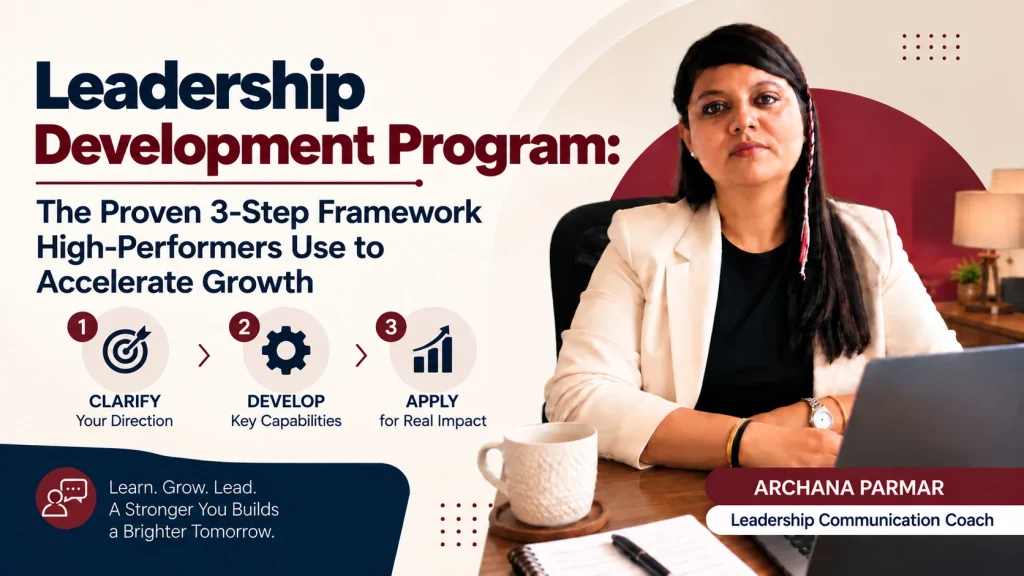
I think of this development journey in three stages:
See → Shift → Show
Step 1: SEE — Understand the Leader You Are Today
Leadership development begins with awareness.
Before trying to change a behaviour, you need to understand what is actually happening.
This sounds obvious.
In practice, it isn’t.
A leader may describe themselves as “direct,” while their team experiences them as dismissive.
Someone may believe they are being thorough, while senior stakeholders experience them as overly detailed.
A leader may think they are giving people autonomy, while their team experiences a lack of direction.
Another may believe they are collaborative because they ask for opinions—but continue making every decision themselves.
The gap between intention and impact is often where the most valuable development opportunities sit.
The framework: Intention → Behaviour → Impact
After an important leadership interaction, ask:
What did I intend?
What did I actually do?
What impact might that have had?
For example:
Intention: “I wanted the team to take ownership.”
Behaviour: “I gave them the problem but no clarity on priorities or decision boundaries.”
Impact: “They waited for me to make the next decision.”
The leader didn’t necessarily have a motivation problem.
They had an execution gap between intention and behaviour.
That is coachable.
What happens in this stage?
A strong leadership development program may use:
- Behavioural assessments
- 360-degree feedback
- Stakeholder perspectives
- Communication observation
- Reflection
- Leadership simulations
- Real workplace examples
The purpose isn’t to produce a personality label.
It is to create a more accurate picture of how the leader currently operates.
Because you cannot deliberately change a pattern you cannot see.
Step 2: SHIFT — Turn Insight Into Behaviour
Awareness feels productive.
But awareness alone doesn’t change leadership.
A leader can understand perfectly well that they interrupt people—and continue interrupting.
They can know that they over-explain—and still spend seven minutes answering a two-minute question.
They can recognise that they avoid difficult conversations—and continue postponing them.
The second stage is therefore behavioural experimentation.
The question changes from:
“What do I need to improve?”
to:
“What will I do differently in the next real situation?”
This is where leadership development becomes practical.
Leadership Development and Behavioural Flexibility
Consider a leader who wants to become more influential.
The answer isn’t necessarily “be more confident.”
They may need to develop several specific behaviours:
- Lead with the recommendation
- Ask before advocating
- Listen for stakeholder interests
- Frame information around business impact
- Disagree without becoming defensive
- Use questions to expand thinking
- Adapt the message to the audience
- Create space for others to contribute
These behaviours can be practised.
And they should be practised in real situations rather than only in a training room.
The framework: Pause → Choose → Practise
Pause
Notice the old pattern.
Choose
Identify the behaviour you want to use instead.
Practise
Apply it in a real conversation.
For example:
Old pattern:
A senior stakeholder challenges your recommendation → you immediately start explaining.
New choice:
Pause → acknowledge the concern → ask one question → respond to the actual objection.
The goal isn’t perfection.
The goal is more choice.
Step 3: SHOW — Make the New Leadership Behaviour Visible
This is the stage many development programs underestimate.
A leader may learn a framework.
They may understand their strengths.
They may practise a new behaviour.
But leadership development only becomes meaningful when other people begin to experience a difference.
That means behaviour needs to become visible in the workplace.
Are you contributing differently in senior meetings?
Are your recommendations clearer?
Are you handling disagreement differently?
Are your team members taking more ownership?
Are stakeholders responding differently to you?
Are difficult conversations happening earlier?
Is your communication creating more movement?
These are better indicators of development than simply completing a programme.
Leadership Development: Behaviour → Evidence → Feedback
Choose one leadership behaviour.
For example:
“I will communicate my recommendation before giving the background.”
Then collect evidence.
Did I actually do it?
What happened?
Did the audience understand faster?
Did the discussion become more focused?
What feedback did I receive?
What would I adjust next time?
This creates a feedback loop.
And that loop is what turns development into capability.
Why High-Performers Often Need a Different Kind of Development
High-performers present a particular challenge.
They are accustomed to learning quickly.
Give them a model and they understand it.
Give them a framework and they can reproduce it.
Give them feedback and they can often tell you exactly what they should have done differently.
But knowing isn’t the same as changing.
In fact, high capability can sometimes make behavioural change harder.
Why?
Because the existing behaviour has usually worked.
The leader became successful by being thorough.
By solving problems personally.
By being available.
By knowing the details.
By being the person others came to for answers.
Then the role changes.
And suddenly those same strengths can become constraints.
Thoroughness becomes over-explaining.
Ownership becomes over-control.
Expertise becomes micromanagement.
Responsiveness becomes lack of boundaries.
Confidence becomes defensiveness.
Problem-solving becomes dependency.
The answer isn’t to eliminate the strength.
It is to recalibrate it for the next level.
Influence Is the Leadership Multiplier
This becomes especially important as leaders move upwards.
At junior levels, you can often rely on expertise and positional authority.
As your scope increases, you need to influence people you don’t directly manage.
- Peers.
- Senior stakeholders.
- Cross-functional teams.
- Clients.
- Boards.
- Partners.
And this changes the nature of leadership.
You can’t simply say:
“Because I said so.”
You need people to understand your reasoning and see why your direction matters.
That requires both influence and persuasion.
Influence begins with understanding.
Persuasion begins with relevance.
If you want someone to support an idea, understand what matters to them.
What are they trying to achieve?
What risks are they managing?
What might they lose?
What would make your proposal valuable from their perspective?
Then connect your message to that reality.
This is not manipulation.
It is disciplined stakeholder communication.
A Leadership Development Program Should Change What Happens at Work
This is the test I would use before investing in any program:
What will be different in the leader’s real working environment?
Not:
“ How many sessions are included?”
Not:
“ How many modules are covered?”
Not:
“ Did they enjoy the workshop?”
Instead:
Will the leader communicate more strategically?
Will they influence more effectively?
Will they handle conflict better?
Will they make decisions with greater clarity?
Will they delegate differently?
Will they create more ownership?
Will they be more effective with senior stakeholders?
Will their team experience their leadership differently?
If the answer isn’t visible in behaviour, the development hasn’t gone far enough.
Training Gives You Tools. Development Changes How You Use Them.
There is an important distinction between leadership training and leadership development.
Training can teach you a framework.
Development helps you understand when, why and how to use it.
For example, a leader can learn the PREP structure:
Point → Reason → Example → Point
But development asks:
When should I use it?
When should I not?
Why do I keep giving too much context?
What happens to my communication when someone senior challenges me?
Why do I find it difficult to state a recommendation directly?
What is happening beneath the communication behaviour?
This is where coaching, reflection, practice and feedback become powerful.
The objective isn’t to make the leader dependent on a framework.
It is to help them eventually think structurally without needing to consciously apply the structure every time.
Three Questions for Leadership Development
Throughout a leadership development journey, I come back to three questions:
1. What am I noticing?
What patterns are becoming visible?
2. What am I choosing?
What behaviour am I intentionally changing?
3. What evidence do I have?
What is different in the real world?
These questions prevent leadership development from becoming an intellectual exercise.
Because insight without action is interesting.
Action without reflection can become mechanical.
But reflection + experimentation + evidence creates development.
Accelerated Growth Doesn’t Mean Faster Learning
The phrase “accelerate growth” can make leadership development sound like a race.
I don’t think that’s particularly useful.
Leadership development is not about becoming perfect faster.
It is about reducing the distance between what your role requires and how you currently operate.
Sometimes that means becoming more assertive.
Sometimes it means becoming less controlling.
Sometimes it means learning to speak with greater authority.
Sometimes it means learning to listen longer.
Sometimes it means developing the courage to have a conversation you’ve been avoiding.
And sometimes the biggest shift is internal:
Moving from:
“I need to prove that I can do this.”
to:
“I need to create the conditions for others to succeed.”
That is a leadership transition.
Is a Leadership Development Program Right for You?
A structured program can be particularly valuable when you are:
- Preparing for your first major leadership role
- Moving from manager to director
- Taking on a broader strategic mandate
- Leading across functions
- Working with increasingly senior stakeholders
- Struggling to influence without formal authority
- Receiving feedback that your communication needs to become more executive
- Finding that behaviours that once worked are no longer producing the same results
The objective shouldn’t be to “fix” the leader.
It should be to help them understand what the next level requires—and deliberately develop the capability to operate there.
The Real Framework: See. Shift. Show.
Leadership development can become unnecessarily complicated.
At its core, I believe the process can be understood in three movements:
SEE
Understand your current patterns and the gap between intention and impact.
SHIFT
Experiment with new behaviours in situations that matter.
SHOW
Create observable evidence that your leadership is producing a different experience and outcome.
That is the journey from awareness to capability.
And ultimately, the best leadership development program isn’t the one that gives you the most information.
It is the one that changes how you think, how you communicate, how you influence, and how other people experience your leadership.
Because your next role may come with a new title.
But the title doesn’t automatically give you the behaviours required to succeed in it.
Your role can change overnight.
Your leadership capability has to catch up deliberately.
That is where real development begins.
Archana Parmar
Leadership Coach: Communication and Influence