When a leader walks into a room, communication has already begun.
Before they make their first argument, people may notice their posture, facial expression, eye behaviour, movement, and vocal energy. Once they begin speaking, their pace, tone, pauses, volume, and emphasis add another layer of meaning.
This is the world of paralinguistic communication.
For leaders, understanding it is important because communication is not only about transferring information. It is also about shaping perception, creating psychological safety, establishing credibility, and building trust.
What Is Paralinguistic Communication?
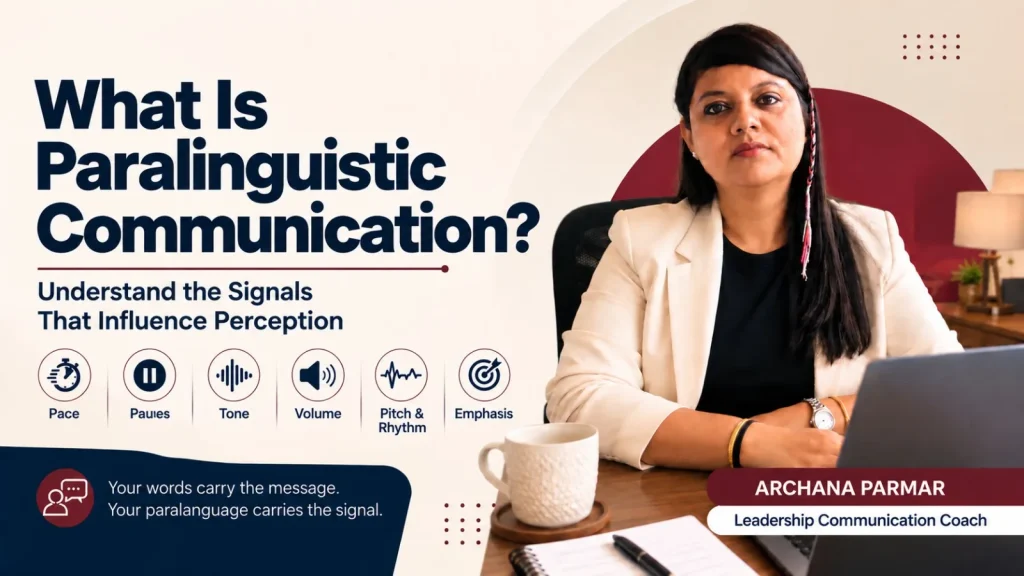
Paralinguistic communication refers to the vocal characteristics that accompany spoken language and influence how a message is interpreted.
These include:
- Tone
- Pitch
- Pace
- Volume
- Rhythm
- Vocal emphasis
- Pauses
- Silence
The words may communicate the intellectual content of a message. Paralinguistic cues can influence how that message feels and how the speaker is perceived.
Consider a leader saying:
“I agree with you.”
The sentence can communicate genuine agreement, reluctant agreement, sarcasm, impatience, or enthusiasm depending on how it is delivered.
The words have not changed.
The signal has.
This is why leadership communication cannot be reduced to vocabulary, grammar, or presentation technique.
Paralinguistic Communication vs. Non-Verbal Communication
These concepts are closely connected, but they are not identical.
Paralinguistic communication primarily concerns the vocal qualities surrounding spoken language.
Non-verbal communication is broader and includes physical and visual behaviours such as posture, gestures, facial expressions, movement, and eye behaviour.
A useful way to think about leadership communication is:
Content → What you say
Paralinguistic delivery → How your voice carries it
Non-verbal behaviour → What your body communicates
The leadership signal emerges from the interaction between these three.
Why Does This Matter for Leadership?
Imagine two leaders delivering the same recommendation.
Leader A speaks rapidly, uses frequent fillers, rarely pauses, and finishes each statement with an upward inflection.
Leader B speaks at a measured pace, pauses before important points, varies vocal emphasis, and maintains steady eye contact.
The content may be identical.
Yet listeners may experience the second leader as more composed and authoritative.
This does not mean the second leader is actually more competent.
It demonstrates something more subtle:
Communication influences the perception of competence.
For leaders, this matters because senior roles involve constant moments of interpretation—meetings, presentations, difficult conversations, negotiations, stakeholder discussions, interviews, and moments of uncertainty.
People are not only asking, “Is this person right?”
They are also unconsciously evaluating:
Can I trust this person?
Do they appear confident in their judgment?
Are they listening?
Can they remain composed under pressure?
The Voice as a Leadership Instrument
A leader’s voice is one of their most important communication instruments.
Consider the impact of pace.
Speaking too quickly can make even excellent thinking sound rushed. Speaking too slowly without sufficient variation can reduce energy and engagement.
Then consider pauses.
A pause can create space for the listener to process an important point. It can also give the speaker time to think rather than filling silence with “um,” “actually,” “basically,” or other habitual fillers.
The objective isn’t to eliminate every filler or manufacture a “powerful” voice.
It is to develop vocal control.
A leader who can deliberately adjust pace, pause, volume, emphasis, and tone has more choices available in high-stakes communication.
Body Language Completes the Signal
Voice is only one part of the equation.
Posture, gestures, facial expressions, and movement can either reinforce or contradict what a leader is saying.
A leader might say, “I’d really like to hear your perspective,” while looking at their phone.
The verbal message communicates openness.
The behaviour communicates something else.
This is why effective leadership communication depends heavily on congruence.
When words, voice, and behaviour point in the same direction, the message feels coherent.
When they conflict, listeners may become uncertain about which signal to trust.
Oculesics: The Power of Eye Behaviour
Another important dimension is oculesics—the study of eye behaviour in communication.
Eye contact can communicate attention, engagement, confidence, and connection.
But effective eye behaviour is not simply about staring at people.
A leader speaking to a group needs to distribute their gaze rather than speaking primarily to one person or constantly looking at their presentation screen.
The objective is visual inclusion.
There is also an important limitation when interpreting eye behaviour.
Eye contact—or the lack of it—cannot reliably tell us whether someone is lying, hiding information, or resisting an idea.
Human behaviour is contextual.
Culture, personality, cognitive processing, emotional state, and situational factors can all influence eye behaviour.
Effective leaders therefore treat non-verbal cues as data to explore, not conclusions to make.
Reading the Room Without Mind-Reading
This is one of the most useful leadership applications of non-verbal communication.
Imagine that you present a proposal and notice that several people become quieter, one person leans back, and another stops taking notes.
It is tempting to conclude:
“They don’t like the proposal.”
But you don’t actually know that.
They could be processing the information, disagreeing with one aspect, feeling tired, or waiting for someone else to respond.
The more productive leadership response is curiosity.
Instead of interpreting the behaviour as fact, you might ask:
“What questions or concerns are coming up for you?”
This transforms observation into dialogue.
That distinction is important. Strong leaders don’t become experts at reading minds. They become better at noticing signals and testing their interpretations.
Three Questions for Leaders
Rather than trying to remember dozens of body-language rules, use three questions:
1. What am I communicating?
Look at your words and message.
Is your thinking clear?
2. How am I delivering it?
Listen to your voice.
Does your pace, tone, volume, and use of silence support the message?
3. What am I showing?
Observe your physical behaviour.
Does your posture, eye behaviour, facial expression, and movement reinforce what you are saying?
These questions create a practical framework for developing leadership presence.
From Performance to Congruence
The goal of studying paralinguistic communication should not be to teach leaders how to “look confident.”
That approach quickly becomes artificial.
The deeper objective is congruence.
Your communication becomes more powerful when your internal intention, verbal message, vocal delivery, and physical behaviour are aligned.
You don’t need to perform authority.
You need to remove the behaviours that unintentionally dilute it.
That might mean slowing down when your thinking is complex.
Allowing silence instead of filling every gap.
Using a gesture to clarify a key idea.
Looking at the person you are speaking to rather than at your screen.
Or simply becoming aware of what your body is doing when you are under pressure.
Leadership communication is therefore more than speaking well.
It is the ability to make your thinking visible, your intention credible, and your presence trustworthy.
Words communicate the message.
Paralinguistic communication shapes the delivery.
Non-verbal behaviour reinforces—or disrupts—the signal.
When all three work together, communication becomes more than information.
It becomes leadership.
Archana Parmar
Leadership coach- Communication and Influence.
Want to go deeper into how vocal delivery affects perceived authority? Read: Paralanguage in Communication: The Hidden Language That Reveals Your True Authority.