We often think leadership communication is about the words we choose.
It isn’t.
Before people process the content of what we say, they are already interpreting how we say it—our pace, pauses, tone, volume, posture, gestures, facial expressions, and eye behaviour.
This is where paralanguage becomes important.
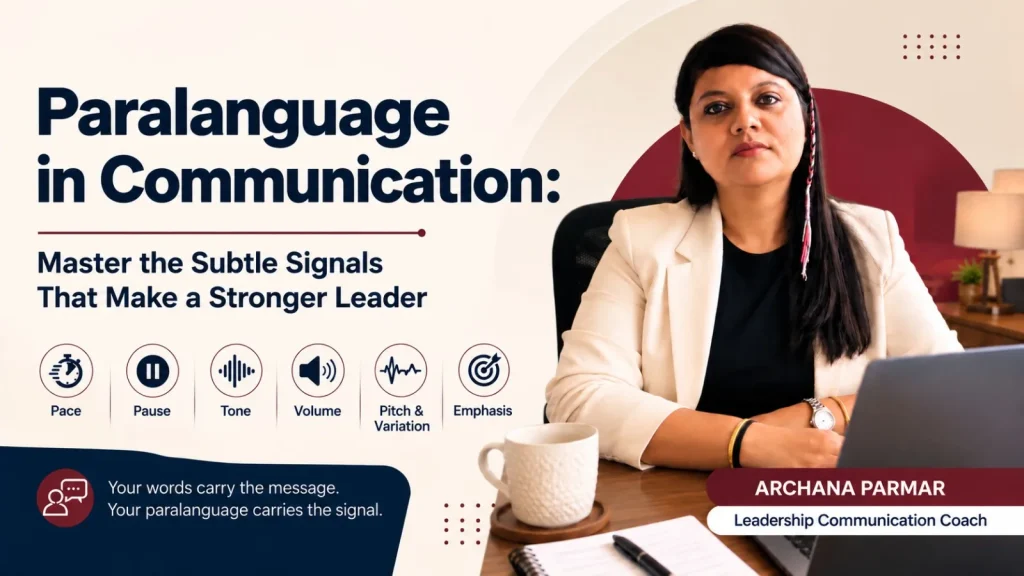
Paralanguage refers to the vocal features that accompany speech but are not the words themselves. Tone, pitch, pace, volume, emphasis, silence, and pauses all influence how a message is interpreted.
But paralanguage does not operate in isolation. It works alongside body language and other non-verbal cues to shape perceptions of confidence, authority, openness, credibility, and trust.
For leaders, this matters because your communication is being evaluated at two levels:
What are you saying? And what does your behaviour suggest while you are saying it?
Authority Is Not Just What You Say
Consider two leaders saying the same sentence:
“I believe we should reconsider this approach.”
The first speaks quickly, looks down, keeps their shoulders slightly rounded, and ends with an upward tone—as though asking a question.
The second pauses before speaking, maintains steady eye contact, sits upright, and delivers the sentence at a measured pace.
The words are identical.
The leadership signal is not.
The second leader is more likely to be perceived as deliberate and confident. This does not necessarily mean they are more knowledgeable or competent. It demonstrates something important about executive communication: perception is influenced by delivery as much as by content.
1. Posture: What Does Your Presence Say Before You Speak?
Posture is one of the first non-verbal signals people notice.
An upright but relaxed posture can communicate confidence and readiness. Collapsed shoulders, excessive fidgeting, or constantly shifting position can unintentionally signal discomfort or uncertainty.
But there is an important distinction between authority and rigidity.
Leadership presence does not require sitting unnaturally straight or adopting a “power pose.” The more useful goal is physical congruence: your posture should support the message you are delivering.
For example:
- Leaning slightly forward can communicate engagement.
- An open torso can signal accessibility.
- Remaining grounded while speaking can convey composure.
- Excessive movement can distract from the message.
The question is not, “Does my posture look confident?”
It is:
“Does my body support the message I want others to receive?”
2. Gestures: Make Your Thinking Visible
Gestures can help listeners understand how you are organizing your thoughts.
A leader explaining three priorities might naturally use three gestures to reinforce the structure. A leader describing growth might use a controlled upward movement.
Effective gestures are usually purposeful rather than continuous.
When gestures become repetitive—touching the face, adjusting clothing, clicking a pen, constantly moving hands—they can compete with the message.
A useful leadership principle is:
Don’t perform confidence. Let your gestures clarify your thinking.
3. Oculesics: The Leadership Signal in Your Eyes
Oculesics is the study of eye behaviour in communication, including eye contact, gaze direction, duration, and movement.
Eye behaviour can influence whether someone experiences us as attentive, confident, evasive, intimidating, or disengaged.
Consider a leader presenting to a senior group. Looking exclusively at one person may create connection with that individual but disconnect everyone else. Looking continuously at slides can make the speaker appear dependent on the material.
Effective eye behaviour involves distribution.
When making an important point, look at an individual long enough to establish connection, then naturally move your gaze across the room.
The objective is not to maintain constant eye contact.
It is to create visual inclusion.
There is also a useful caution: eye behaviour should not be interpreted as a simple psychological lie detector. Looking away does not automatically mean someone is hiding something. Cultural norms, cognitive processing, anxiety, context, and individual differences all influence eye behaviour.
Non-verbal cues are signals—not definitive evidence.
4. Paralanguage: Your Voice Carries the Leadership Signal
Now return to the voice.
A senior leader may have excellent ideas but weaken their impact by speaking too quickly, using a consistently low volume, adding excessive fillers, or allowing every statement to sound tentative.
Compare:
“I think we could possibly consider changing the timeline.”
with:
“I recommend that we change the timeline.”
The difference isn’t merely vocabulary.
The second statement is supported by a more decisive linguistic structure. If it is delivered with an appropriate pause, steady pace, clear articulation, and grounded tone, the overall signal becomes stronger.
This is the practical power of paralanguage.
The Principle of Congruence
The strongest leadership communication occurs when words, voice, and body are aligned.
If your words communicate confidence but your voice sounds hesitant, people may notice the mismatch.
If your words communicate openness but your posture is closed, the same thing can happen.
This does not mean leaders need to monitor every movement. Excessive self-monitoring can actually make communication less natural.
Instead, develop awareness of a few high-impact behaviours:
Posture → Am I grounded?
Gestures → Are they supporting my message?
Eyes → Am I creating connection and inclusion?
Voice → Does my pace, pause, tone, and emphasis match my message?
Expression → Does my face support the emotional meaning of what I am saying?
Leadership presence is rarely created by one dramatic behaviour.
It is built through hundreds of small signals that tell people whether they can trust your judgment, follow your direction, and engage with you.
Your words tell people what you think.
Your paralanguage and body language often tell them how much confidence they should place in it.
That is why mastering leadership communication is not simply about speaking better.
It is about becoming more intentional about the complete message you are sending.
Archana Parmar
Leadership coach- Communication and Influence.
To understand the broader science behind voice, body language, and leadership perception, read: What Is Paralinguistic Communication? The Science Behind Non-Verbal Leadership