You walk into a meeting. You know your subject and have prepared well. Yet, someone else speaks with less expertise and somehow appears more authoritative.
What are they doing differently?
Often, it isn’t charisma. Instead, it is executive presence — the set of verbal, vocal, behavioural and contextual signals that shape how others perceive your credibility, authority and leadership readiness.
Executive presence isn’t about looking powerful. It is about communicating in a way that makes people trust your thinking, understand your position and feel confident following your lead.
As an executive presence coach, I see five signals repeatedly influencing how leaders are perceived. These signals also play an important role in communication capability building.
1. Clarity: Can People Understand Your Thinking Quickly?
Senior leaders operate in environments where attention is scarce. Therefore, if your message takes five minutes to reach its point, your expertise can get buried beneath your delivery.
Executive presence begins with clarity of thought.
Instead of beginning with everything you know, begin with what your audience needs to know. Try this structure:
Point → Reason → Implication → Action
For example:
“My recommendation is to delay the launch by two weeks. The testing team has identified three unresolved issues. Launching now increases operational risk. I recommend using the additional two weeks to close the gaps and then proceed.”
Notice the difference.
The speaker isn’t demonstrating how much they know. Instead, they are demonstrating that they know what matters.
2. Vocal Authority: Does Your Voice Support Your Message?
Your words communicate content. However, your voice communicates conviction.
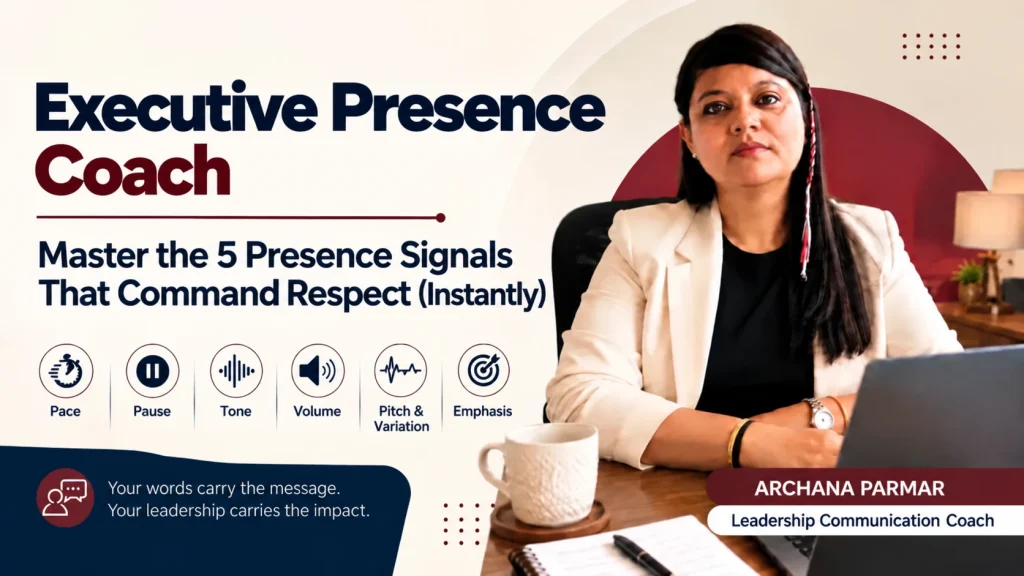
Pace, pauses, emphasis, volume and intonation influence how your message is received.
A common mistake is trying to sound “confident” by speaking louder or faster. In contrast, executive vocal presence is usually more controlled.
Pause before an important point. Similarly, slow down when delivering a recommendation. Finish statements cleanly instead of allowing your voice to rise as though every statement were a question.
In addition, eliminate habitual fillers that dilute your message.
The objective isn’t to create an artificial “executive voice.” Instead, it is to ensure that your delivery doesn’t contradict your message.
3. Positioning: Are You Contributing Information—or a Point of View?
This is one of the biggest shifts from professional communication to executive communication.
A subject-matter expert often says:
“Here are the facts.”
An executive communicator adds:
“Here is what I believe these facts mean, and here is what I recommend we do.”
That difference matters.
Leadership communication requires a point of view.
You don’t need to have certainty about everything. However, when you have analysed an issue and formed a recommendation, communicate it.
Replace:
“We could perhaps consider…”
with:
“I recommend that we…”
Similarly, replace:
“I’m not sure, but I think…”
with:
“My assessment is…”
The goal isn’t aggression. Instead, it is appropriate authority.
4. Composure: What Happens to Your Communication When You Are Challenged?
This is where executive presence becomes visible.
Anyone can appear composed when the conversation goes according to plan. The stronger test is what happens when someone says:
“I disagree.”
“Why didn’t you anticipate this?”
“That doesn’t answer my question.”
“What evidence do you have?”
Under pressure, some professionals start over-explaining. Others become defensive. Some retreat from their original position.
Executive presence requires the ability to stay present while staying clear.
Try responding to a challenge with:
Acknowledge → Clarify → Respond
For example:
“That’s a fair concern. The risk you’re highlighting is X. Based on the available data, my recommendation remains Y because Z.”
You don’t need to win every disagreement. Instead, you need to demonstrate that disagreement does not destabilise your communication.
5. Audience Awareness: Can You Make Your Expertise Relevant to the Person in Front of You?
One of the most underestimated executive communication skills is knowing that the same message cannot be delivered in the same way to every stakeholder.
A technical leader speaking to engineers may discuss architecture. However, the same leader speaking to the CFO may need to discuss cost, risk and business impact.
Speaking to the CEO may require the decision, strategic implication and trade-off.
The information hasn’t necessarily changed. Instead, the frame has.
Executive presence therefore isn’t simply about how you present yourself. It is also about how accurately you read the room.
Before an important conversation, ask yourself:
What does this person need from me—information, interpretation, reassurance, a recommendation or a decision?
That question can radically change how you communicate.
Executive Presence Isn’t Performance. It’s Alignment.
The strongest executive communicators aren’t necessarily the loudest people in the room.
Instead, they are often the people whose:
thinking is clear,
message is precise,
voice is controlled,
position is visible,
and behaviour remains steady under pressure.
That is why executive presence cannot be built through superficial presentation tips alone.
It requires the alignment of Presence, Precision and Power.
Presence: How you show up.
Precision: How clearly you communicate your thinking.
Power: How effectively your communication influences understanding, decisions and action.
Communication Capability Building and Executive Presence
Strong executive presence requires more than presentation techniques. It also requires consistent development of communication skills across different professional situations.
This is where communication capability building becomes important.
Communication capability building focuses on developing the ability to communicate clearly, confidently and effectively across meetings, presentations, stakeholder conversations and challenging situations.
The objective is not simply to sound confident. Instead, it is to ensure that your communication reflects your expertise, thinking and leadership responsibility.
What Does Communication Capability Building Include?
Effective communication capability building can involve several areas, including:
- Clear and structured communication
- Executive communication
- Leadership communication
- Vocal presence
- Stakeholder communication
- Difficult conversations
- Presentation skills
- Audience awareness
- Communication under pressure
- Communicating recommendations effectively
These capabilities can help leaders communicate their thinking more clearly while adapting their message to different audiences and situations.
Common Executive Communication Mistakes
Even experienced professionals can make communication mistakes that affect how their leadership presence is perceived.
Over-Explaining
Some professionals provide too much background information before reaching their main point. As a result, an otherwise strong message can become difficult to follow.
Using Too Many Qualifiers
Words such as “maybe,” “perhaps,” “I think” and “I’m not sure” can sometimes make a recommendation sound less certain than intended.
Sharing Facts Without a Recommendation
Providing information is important. However, leadership communication often requires more than presenting facts. It requires explaining what those facts mean and what you recommend doing next.
Becoming Defensive Under Pressure
A challenging question does not have to result in a defensive response. Instead, acknowledge the concern, clarify the issue and respond with evidence.
Using the Same Communication Style With Everyone
Different stakeholders may require different levels of detail, context and business relevance. Therefore, adapting your communication to the audience is an important leadership skill.
How to Strengthen Your Executive Presence
Before an important meeting, presentation or leadership conversation, ask yourself:
- What is my main point?
- Can people understand it quickly?
- Is my voice supporting my message?
- Have I communicated my point of view?
- Have I made a clear recommendation?
- How will I respond if someone challenges my position?
- What does this person need from me?
- Do they need information, interpretation, reassurance, a recommendation or a decision?
These questions can help you become more intentional about your communication.
They can also support a practical approach to communication capability building by helping you identify specific behaviours that can be strengthened over time.
Executive Presence Isn’t About Changing Your Personality
Executive presence isn’t about being the loudest person in the room.
It isn’t about looking powerful.
It isn’t about changing your personality.
And it isn’t about performing confidence.
Instead, it is about making sure that your communication reflects your thinking, expertise and leadership responsibility.
If you’re already technically strong but feel that your communication doesn’t consistently reflect your level of expertise or leadership responsibility, the question may not be whether you need to “communicate better.”
It may be:
Which executive communication signal is currently weakening the perception of your leadership—and what behaviour would change it?
That is where targeted executive communication coaching begins.
Through focused communication capability building, leaders can work on the specific communication behaviours that influence how their expertise, authority and leadership presence are perceived.
The strongest executive communication is not necessarily louder or more complicated. Instead, it is clear, precise, purposeful and steady when it matters most.
When Presence, Precision and Power work together, your communication can better reflect the level of leadership you bring to the room.