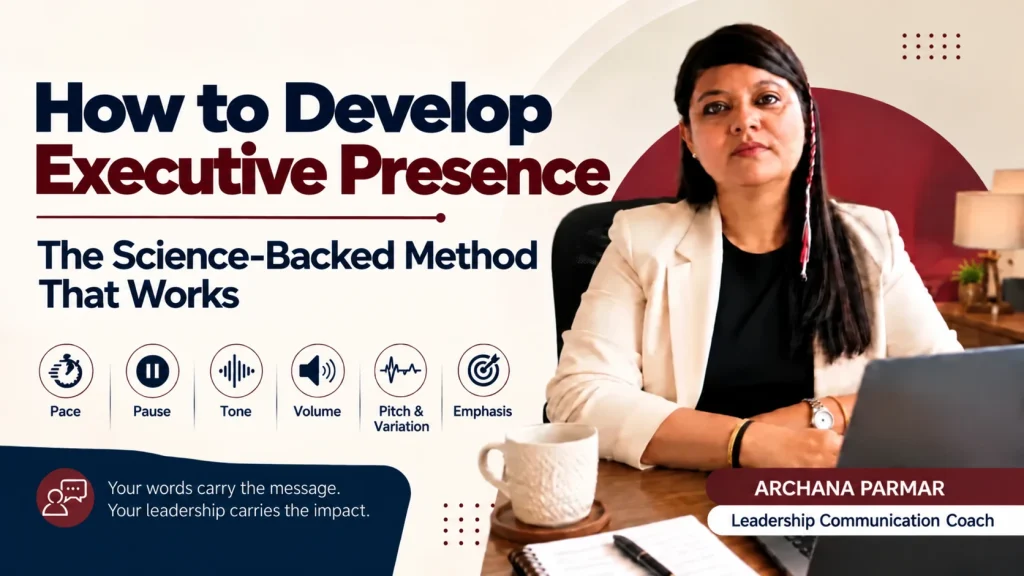
Executive presence is often treated as something you either have or you don’t.
That is a problem.
If executive presence were simply about charisma, confidence, or personality, it would be difficult to develop on purpose. But it is not. Executive presence is better understood as a set of behaviours that shape how people experience your leadership.
After working with hundreds of professionals and leaders on communication, I have found that meaningful change rarely comes from telling someone to “be more confident.” Instead, it comes from identifying the behaviours that weaken their impact and then practising better ones.
Here is the method.
1. Stop Trying to “Look Executive”
The first mistake is treating executive presence as a performance.
People often try to:
- speak in a deeper voice
- use complicated vocabulary
- talk more
- appear serious
- dominate meetings
- remove every “um” and “uh”
- copy senior executives
These changes may affect how someone looks or sounds. However, they do not always create credibility.
Executive presence is not about looking powerful. It is about showing clear signs of leadership.
Research in social perception and leadership shows that people form quick impressions based on signals such as competence, confidence, warmth, and authority.
The practical point is simple:
You do not develop executive presence by creating a new personality. You develop it by making your existing leadership skills easier to see and trust.
2. Diagnose the Signal, Not the Personality
Instead of asking:
“Why don’t I have executive presence?”
Ask:
“What am I doing that makes people see me as less senior than I intend?”
This question gives you something specific to work on.
For example, you may:
- give too much background before making your point
- hesitate before sharing a recommendation
- change your tone when someone challenges you
- use too many qualifiers
- avoid disagreement
- answer a different question from the one asked
- focus on technical detail when the audience needs the business impact
- start speaking too quickly when you are under pressure
These are behaviours, not personality traits.
More importantly, behaviours can be seen, practised, and changed.
3. Build Executive Presence Through Three Dimensions
My approach to executive communication uses three dimensions: Presence, Precision, and Power.
Presence — How You Show Up
Presence is about how you come across in the moment.
It includes:
- composure
- vocal control
- physical communication
- confidence
- responding well under pressure
The key question is:
Does your behaviour communicate steadiness?
Imagine you are giving a board update and a director suddenly questions one of your assumptions. Do you rush to defend yourself? Do you start giving too much detail?
Or can you pause, listen, and answer calmly?
That response is part of executive presence.
Precision — How You Communicate Your Thinking
Precision is about making your thinking easy to understand.
It includes:
- clarity
- structure
- brevity
- relevance
- understanding your audience
Ask yourself:
Can people understand what matters without having to work too hard to find the point?
For example, compare these two statements:
“I think we could perhaps consider…”
with:
“My recommendation is…”
The second statement is direct and clear. It does not require a different personality. It requires a better communication habit.
Power — What Your Communication Enables
Power is not about controlling the room. It is about what your communication helps people do.
It includes:
- assertiveness
- influence
- recommendations
- disagreement
- decision-making
- stakeholder alignment
The question is:
Does your communication move the conversation forward?
This is why executive presence is more than body language.
A polished communicator may sound confident but still have limited influence if they never take a position. Strong executive communication should help people understand an issue, make a decision, or take action.
4. Practise Behaviour, Not Confidence
This may be the most important shift.
Confidence is often treated as the starting point:
“Once I feel confident, I will speak up.”
In practice, the opposite can also happen.
When you repeatedly perform a difficult behaviour successfully, you build evidence that you can handle it. Over time, that evidence can strengthen your confidence.
So instead of saying:
“Be more confident.”
Create a clear behaviour to practise.
For example:
Old behaviour:
“I think we could perhaps consider…”
Target behaviour:
“My recommendation is…”
Then practise it.
Do it again. Then practise it in a harder situation.
What happens when someone challenges the recommendation?
What happens when the client disagrees?
What happens when a senior leader interrupts?
What happens when you have no time to prepare?
That is where the real development begins.
5. Use Progressive Exposure
Executive communication has a hidden challenge: a behaviour that works in a comfortable setting may disappear under pressure.
Someone may give an excellent prepared presentation but struggle when the CEO asks an unexpected question.
Likewise, someone may speak confidently with colleagues but become much more cautious with senior stakeholders.
In another situation, a person may express disagreement clearly in writing but step back during a live discussion.
For that reason, practice should become harder over time.
Stage 1: Prepared
Start by delivering the message with enough time to prepare.
Stage 2: Familiar but Unprepared
Next, speak about a topic you know well without preparing your exact response.
Stage 3: Unfamiliar
Then respond to a topic or question you have not rehearsed.
Stage 4: Challenged
After that, introduce disagreement, interruption, or pushback.
Stage 5: High-Stakes
Now recreate the conditions where the behaviour really matters. This could be a board discussion, a difficult client meeting, or a conversation with a senior leader.
Stage 6: Workplace Transfer
Finally, use the behaviour in a real meeting or leadership conversation.
The goal is not perfect performance.
It is behavioural stability under pressure.
Can you remain clear when someone disagrees with you? Can you maintain your position when the conversation becomes uncomfortable? Can you slow down and think when you do not have an immediate answer?
That is the ability you are building.
6. Measure What Changed
“She seems more confident” can be useful feedback. Still, it is not enough.
A stronger coaching process looks for specific, observable changes.
For example:
Before: Takes two minutes to reach the recommendation.
After: States the recommendation within 20 seconds.
Before: Backtracks when challenged.
After: Acknowledges the challenge and maintains a reasoned position.
Before: Explains technical details without connecting them to business impact.
After: Frames technical information around risk, cost, opportunity, or the decision that needs to be made.
Now the change is visible.
Once you can observe a behaviour, you can also practise it, measure it, and improve it.
Executive Presence Is Built, Not Bestowed
The most useful question is not:
“Do I have executive presence?”
Instead, ask:
“Which behaviours currently weaken the perception and impact of my leadership?”
That question changes the entire coaching conversation.
Executive presence is not a personality transplant. It is the deliberate development of how you:
show up → communicate → respond → influence.
The real test, however, is not whether you can perform these behaviours in a coaching session.
It is whether you can use them when the stakes are high, the question is unexpected, the room disagrees with you, and you have very little time to think.
That is where executive presence becomes leadership presence.
And that is where deliberate practice matters most.