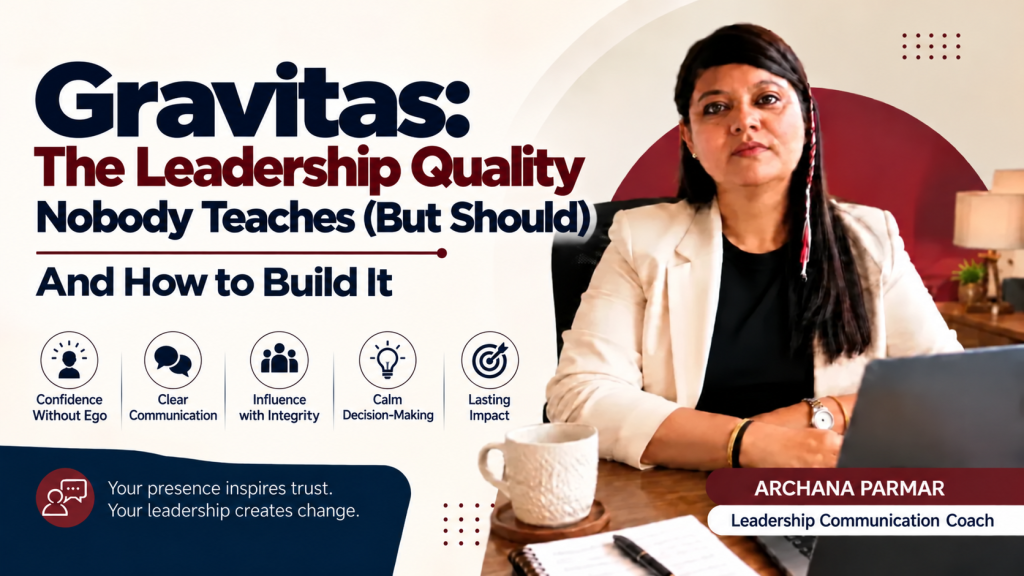
You can be the person everyone relies on for answers and still struggle to sound like the person who should be making the call.
You know your subject. You have earned trust. You have years of experience behind your judgement. Yet put you in a senior meeting, ask for a recommendation without warning, or challenge your position in front of a room full of stakeholders, and your communication can suddenly feel smaller than your capability.
That gap is often described as a lack of gravitas.
The phrase can sound vague, even intimidating. But gravitas has very little to do with being intimidating, speaking in a deeper voice, or acting overly serious. It does not require you to become colder or less approachable.
Gravitas is the ability to project credibility, composure and authority when the situation calls for it.
And unlike personality, much of it can be developed.
Your expertise gets you in the room. How you communicate determines what happens next.
There is a point in many careers where being the expert is no longer enough.
Imagine a technically strong leader sitting in a senior leadership meeting. The CEO asks, “Which option would you recommend?”
They know the answer.
Instead of leading with it, they start explaining the history of the project. Then the technical constraints. Then three exceptions. Then what happened in the previous quarter. By the time they reach their recommendation, the room has already moved on.
Nothing is wrong with their knowledge.
The issue is executive translation.
At senior levels, people are listening not only for what you know, but for whether you can make sense of it for everyone else. Can you separate signal from noise? Can you explain what matters? Can you make a recommendation? Can you show the consequences of a decision?
That is a major part of the shift from expert to executive.
Your expertise remains the foundation. What changes is how clearly and deliberately you put that expertise to work.
Gravitas is not dominance. It is self-command.
People sometimes associate authority with being forceful, highly assertive or the loudest person in the room.
That is not gravitas.
I have seen highly capable professionals become less decisive the moment they speak with a senior stakeholder. Others think out loud for so long that their strongest point gets buried. Some are so accommodating that they hesitate to set boundaries. Others are excellent problem-solvers but struggle to move from answering questions to giving direction.
Their situations may look different, but the underlying pattern is similar:
Their capability is stronger than the behaviour people consistently see.
That is where gravitas becomes useful.
It creates greater alignment between what you know, what you believe, how you communicate and how you behave when the pressure rises.
The goal is not to perform authority. It is to make your existing capability more visible.
Five behaviours that make gravitas easier to see
1. Have a point of view
Experts are often trained to present the facts.
Leaders are expected to interpret them.
There is a real difference between saying:
“Here are the options.”
and saying:
“I recommend Option B because it gives us the strongest outcome while keeping the main risk within an acceptable range.”
The second statement does not claim perfect certainty. It demonstrates judgement.
You will not always have complete information. You may even be wrong. That is part of leadership.
What matters is being willing to say, “Based on what we know, this is what I recommend.”
When the role calls for judgement, make your judgement visible.
2. Get to the point sooner
One of the easiest ways to unintentionally dilute authority is to take too long to arrive at the main point.
Usually, the intention is good. You want to be precise. You want people to understand the background. You do not want to leave out something important.
But imagine a senior stakeholder asks, “Are we ready to launch?”
A long explanation about testing, dependencies and previous discussions creates uncertainty before the answer even arrives.
A stronger structure is:
Headline → rationale → implication → detail
For example:
“Yes, I recommend we launch on Monday. The core issues are resolved, the remaining items are low risk, and delaying would create more operational disruption. I can walk you through the outstanding details.”
Now the listener knows your position immediately.
Do not make people search your explanation for the conclusion. Give them the conclusion first. Let the detail support it.
3. Stay composed when your position is challenged
You learn a lot about communication when someone disagrees with you.
A stakeholder interrupts.
A colleague questions your assumption.
A senior leader asks, “Why didn’t you anticipate that?”
Under pressure, capable professionals can start speaking faster, defending every detail, or abandoning their position before they have properly considered the challenge.
A more grounded approach is:
Acknowledge → clarify → respond
For example:
“That’s a valid concern. The assumption you’re challenging is X. Based on the information we have, my recommendation remains Y because of Z.”
This does not mean you have to win the exchange.
It means you can stay present while the pressure rises.
Gravitas is often less about having the perfect answer and more about showing that disagreement does not throw you off your centre.
4. Make your expertise useful to the person in front of you
Strong professionals sometimes make the mistake of giving everyone the same version of their expertise.
It rarely works.
An engineer may need to discuss architecture, dependencies and technical trade-offs with their team. A CFO may care more about cost, exposure and financial risk. A CEO may want the strategic implication and the decision required. A client may simply want to know what changes for their business.
The knowledge is the same.
The communication should not be.
Think about an unexpected CEO question. You might have ten minutes of technical reasoning in your head, but the room may need one sentence:
“The technical change is manageable. The bigger issue is the impact on the delivery timeline, and I recommend we adjust the launch date by one week.”
That is not simplifying your expertise. It is making your expertise useful.
Gravitas includes knowing what the room needs from what you know.
5. Stand your ground without needing to be right
There is another misconception about authority: that confident leaders never change their minds.
In reality, being able to reconsider your position can make you more credible.
The key distinction is between flexibility and instability.
Changing your recommendation because new information genuinely changes the situation is not weakness. It is sound judgement.
A leader might say:
“I hadn’t considered that implication. Given this information, I’d revise my recommendation.”
That communicates something valuable. You were confident enough to take a position and secure enough to reassess it.
Gravitas is confidence without attachment to being right.
You can hold your position firmly without turning it into an identity you have to defend at all costs.
How to build gravitas in real life
Knowing these behaviours is not enough.
You build gravitas by practising them in situations where they actually matter.
Start with one high-value moment in your working life. Perhaps it is presenting to senior stakeholders, answering unexpected questions, challenging a decision, setting a boundary or explaining technical information to a non-technical audience.
Then define the behaviour you want to change.
Instead of:
“I need to explain everything so they understand.”
Try:
“I will state my recommendation first and add detail only when it helps the decision.”
Then rehearse it progressively.
Practise when you are prepared.
Then try it without preparation.
Practise with interruption.
Practise when someone disagrees.
Practise under a tight time limit.
Then take it into a real meeting.
That sequence matters because gravitas is not built by knowing what to do when everything is comfortable. It is built when the behaviour still shows up when you are interrupted, challenged or under pressure.
The real quality underneath gravitas
The more I work with professionals across technical, finance, management and leadership roles, the more clearly I see that gravitas is not mainly about appearance.
It is about self-command.
Can you organise your thinking before you speak?
Can you make a recommendation without hiding behind information?
Can you resist the urge to over-explain?
Can you stay steady when someone pushes back?
Can you adjust your language without losing your message?
Can you use your expertise to help other people make better decisions?
That is what people often experience as gravitas.
And perhaps the most useful part is this:
You do not need to become a different person to develop it.
You need to make the leadership capability you already possess more visible, deliberate and reliable.
Your expertise may have earned you the seat at the table.
Your gravitas shapes what happens once you are there.